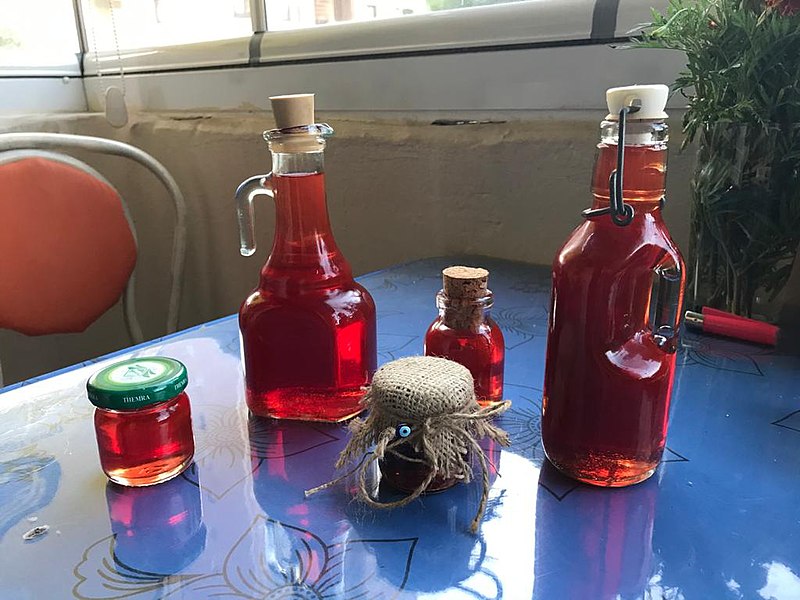
 Homemade St. John's Wort Oil (Hypericum perforatum oil), Wikipedia commonsA previous blog about Polish lac or Polish cochineal got me thinking. Specifically, I was intrigued by the importance of the colour red, and the alternative name for the Polish lac dye produced from the cochineal larvae, namely "Saint John's Blood".
This struck a chord in my memory as I know another plant that goes by this name, and for the very same reasons.
St. John's Wort (Hypericum perforatum) is a small plant with yellow flowers found native in Eurasia, but it is also an invasive weed in North and South America, South Australia and South Africa. The plant blooms annually, peaking around the summer solstice, close to June 24th, St. John's Day (St John the Baptist), hence the name.
The Polish name is also linked to the blood red colour of the dye produced when the insects are crushed. The same colour is produced when the seed pods of the St. John's Wort are pressed.
Historically, the plant is famous for its use in medicines, and this application goes as far back as Ancient Greece when the oil was used as a treatment for wounds, burns, and as a natural anti-depressant and anti-anxiety treatment among other things, although this has no medical or scientific basis and (let me add) is generally not advisable to use.
The oil from the crushed seed pods is often infused with olive oil, a process that also dates back to Ancient Greece. Furthermore, and on a different level, Greek and Roman folklore stated that picking the flowers the night before the summer solstice would help ward off demons and ghosts.
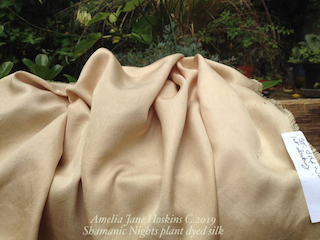 Cloth dyed with St. John's wort. Photo by Amelia Hoskins, 2019.St. John's Wort can be used for dyeing, and produces a wonderful range of shades, depending on the mordants used, the time of year, and the number of dye baths. The most common colour is surprisingly a pale golden yellow! Amelia Hoskins published a lovely blog in 2020 covering the process of using St. John's Wort for dyeing.
What surprised me most when looking at the Polish cochineal and St. John's Wort, is how two entirely different natural materials can be named after the same day of the year, for the same reasons, and yet be used in completely different ways!
The word "wort" also piqued my interest, and it turns out it comes from the Old English word "wyrt" which means plant. It derives further from the Germanic word *wurtiz which means root (compare Dutch wortel for a root or carrot).
The natural world is capable of producing an incredible array of unique colours, I will certainly be keeping an eye out for the lovely golden yellow colour of St. John's Wort!" Hope you found this interesting!
AJ Salter, 9 August