Over the last month or so we have had various questions about the TRC Reference Collection, and in particular how it is organised and used. These questions have come from individuals as well as various museums and groups, notably one in Kortrijk, Belgium, as well as Arraiolos (Portugal) and Lucknow, (India). So this blog is about the TRC Reference Collection and its function(s).
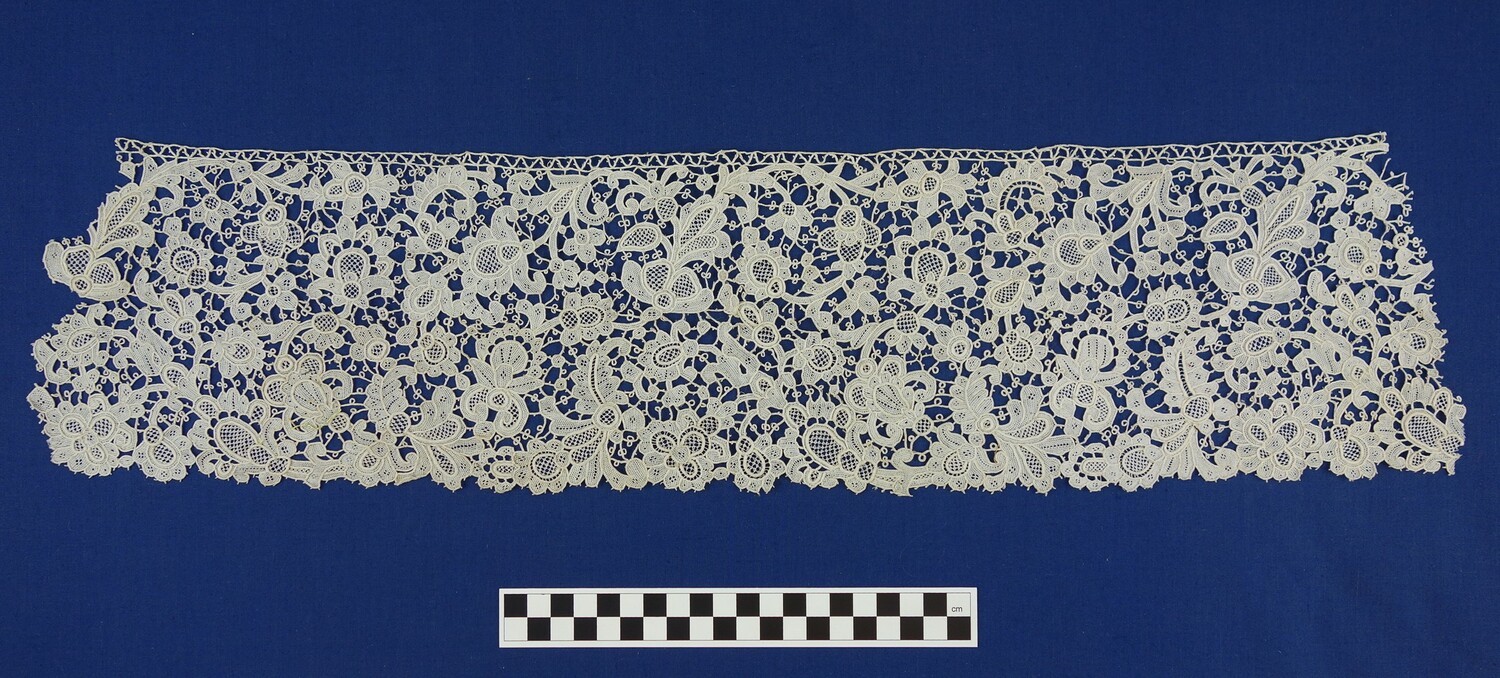 Sample of needle lace, the Netherlands, 20th century (TRC 2007.0559).
The TRC Collection in general
But before talking about the Reference Collection, it is necessary to briefly say something about the TRC Collection in general, which includes the Reference Collection. The total TRC Collection currently stands at nearly 42,000 textiles, garments and accessories. The collection emphasises not only the objects but also the stories behind them. The TRC Collection is based on three specialisations: (a) regional textile techniques and technology, (b) dress and identity worldwide, and (c) the Reference Collection.
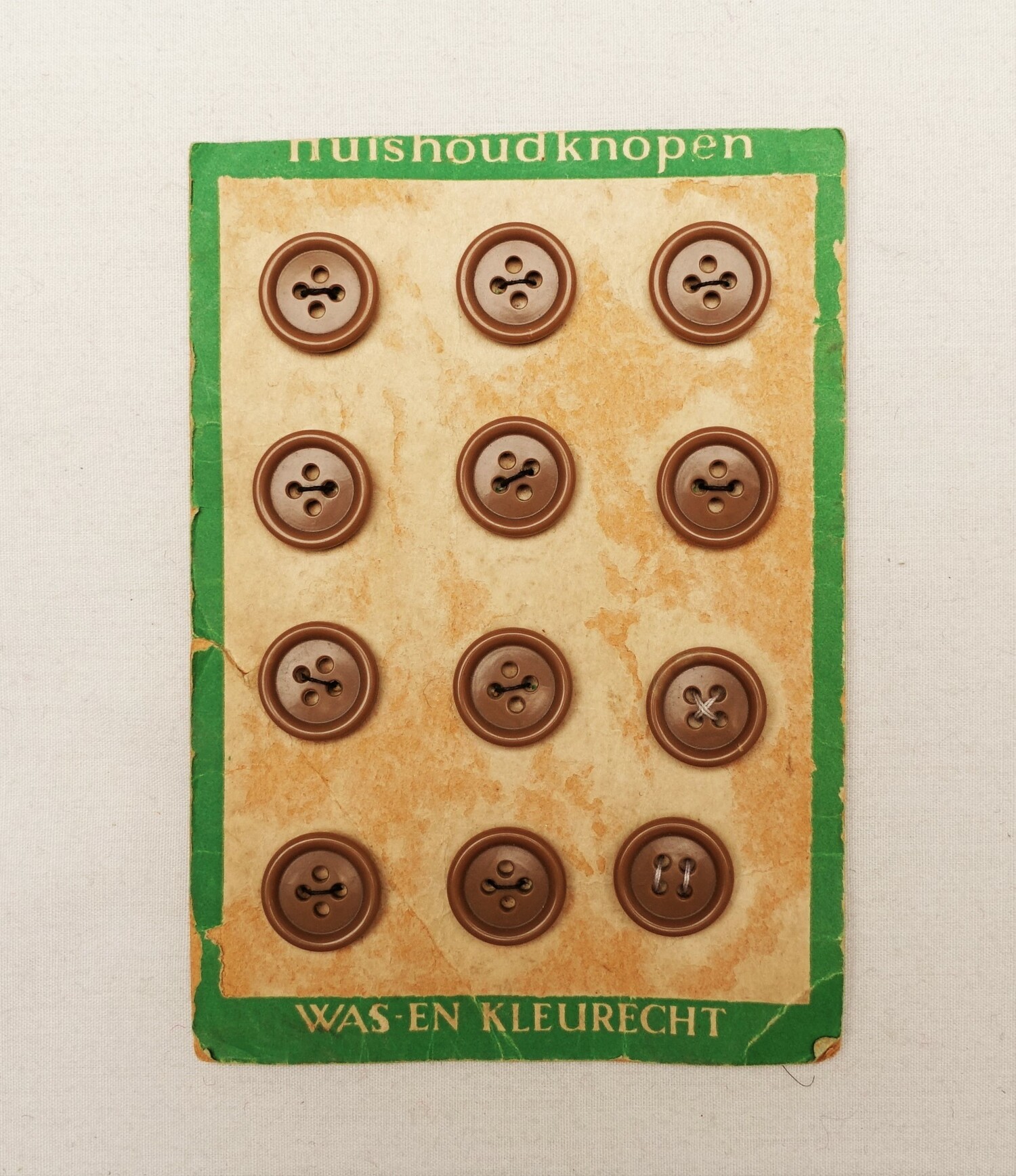 Sheet of buttons, the Netherlands, 1920s-1930s (TRC 2022.3109).The technique and technology focus deals with items such as hand spindles from around the world, (small) looms, such as back strap looms from Peru and Indonesia, and Bedouin horizontal ground looms from Jordan, as well as textiles (woven and non-woven forms), etc., associated with specific groups or countries.
In contrast the dress and identity specialisation deals with the concept of what people wear and do to their bodies in order to say ‘I am’ or ‘I would like to be’. This focus includes garments, headwear, footwear and accessories (such as jewellery, bags, fans, parasols, etc).
None of these items have to be beautiful or masterpieces of their type for them to be included in the TRC Collection. In fact we prefer to look for what is typical, technically interesting, and/or have a background story/context, rather than being exceptional or elitist. Which is not to say we turn our noses up at a lovely item!
 Piece of machine embroidery, European, late 20th century (TRC 2020.1033).Why the TRC Collection?
A feature that is shared by textile people throughout the world is the need/desire to handle cloth! At least 50% of the information about the nature of a piece of cloth sample comes through the fingers, so saying a photograph of a textile or look at textiles and dress through the glass of a showcase is good enough (comments that were said to me by a deputy-director of a large museum) clearly shows their lack of understanding about this basic element of textiles. The TRC Collection is a Handling Collection. The textiles are tactile and in order for someone to gain more information the textiles need to be touched and turned over as both the front and back ‘speak’! This of course does not mean that we don't look after our textiles in a suitable manner, quite the contrary.
 Imitation moiré cloth, Western, 1920s (TRC 2022.2849).More conventional museums, with a preservation rather than handling purpose, may benefit from the presence of this type of handling collection, with objects that can be touched by visitors, students, academics, etc. It would take pressure off the main collection while fulfilling educational and research commitments. It can also be used when talking with community groups about different types of, for example, embroidery. The history of a particular type of cloth or its possible variations can be discussed much more easily if there are samples to handle, examined and commented upon. But this is not for us to decide. The TRC Collection is, for the greater part, already a handling collection!
The TRC Reference Collection
The third specialisation within the TRC Collection is the Reference Collection. It currently includes about 10,000 items. The majority of these are 20th century to the present day in date and come from many different sources. We are deliberately including a range of fibres and structural forms (such as woven, knitted, non-woven fabrics) that are used for modern textiles. We have just added examples of, for instance, cupro, elasthan, modal, nylon, and tenzel. Some of these materials are knitted, while others are woven. Many more will be added over the next few months.
 Band sample, early 20th century (TRC 2003.0205).So part of the work for the TRC Reference Collection is to deliberately acquire modern, commercial textiles and related items, as these items are of significance to present day life, and will eventually become historic items over the course of time. On a more practical note, it is much easier to collect them now than to try and do it after fifty years.
The Reference Collection can be used for many purposes. In recent years sustainability has become a buzz word, and many textiles are currently advertised as being bio-, sustainable, green, etc. But actually how many can be classified as such? Cupro, for example, is sometimes sold as sustainable because it is made of cotton lint, a waste product of the cotton industry. Yet the range and quantity of chemicals used to make cupro is staggering, so much so that its production in the US has been banned! Similarly, a recent TRC blog about modern ‘leather’ has given an indication of some of the problems associated with this product. The TRC collection can be used to study these 'new' textiles.
But what can be further gained by having a reference collection? The textiles are there for comparative purposes, for help visually and structurally with defining terms so that the TRC main database is consistent in the use of terminology, to be used for educational purposes during courses, study days and workshops, as well as providing a source of inspiration. We are, for instance, working on having study days about leather and the range of artificial and synthetic fibres currently on the market.
 Japanese-style, Western cloth sample, 20th century (TRC 2017.0806).What is …..
All the pieces in the Reference Collection come with the question – ‘What is …?’ , such as what is wool, what is flax, what is a twill weave, what is velvet, what is discharge printing, what is embroidery?
We have been gradually building up the Reference Collection for about five years now and at first we concentrated on lace, as well as woven and printed textiles, in order to find out what was needed, how to do it and what were the problems. Based on our growing experience in making such a collection we have recently deliberately expanded it to look from fibres to end products with various sub-sections, which include both actual samples, as well as relevant (small) tools and equipment.
The vast majority of objects in the Reference Collection are printed forms that date to the 20th century (especially the 1930s, 1950s and 1960s). All of these pieces can be handled and examined in detail, in fact we encourage people to touch them – as noted above textiles are often about texture and structure, not just their general, visual appearance, and this is something we understand at the TRC.
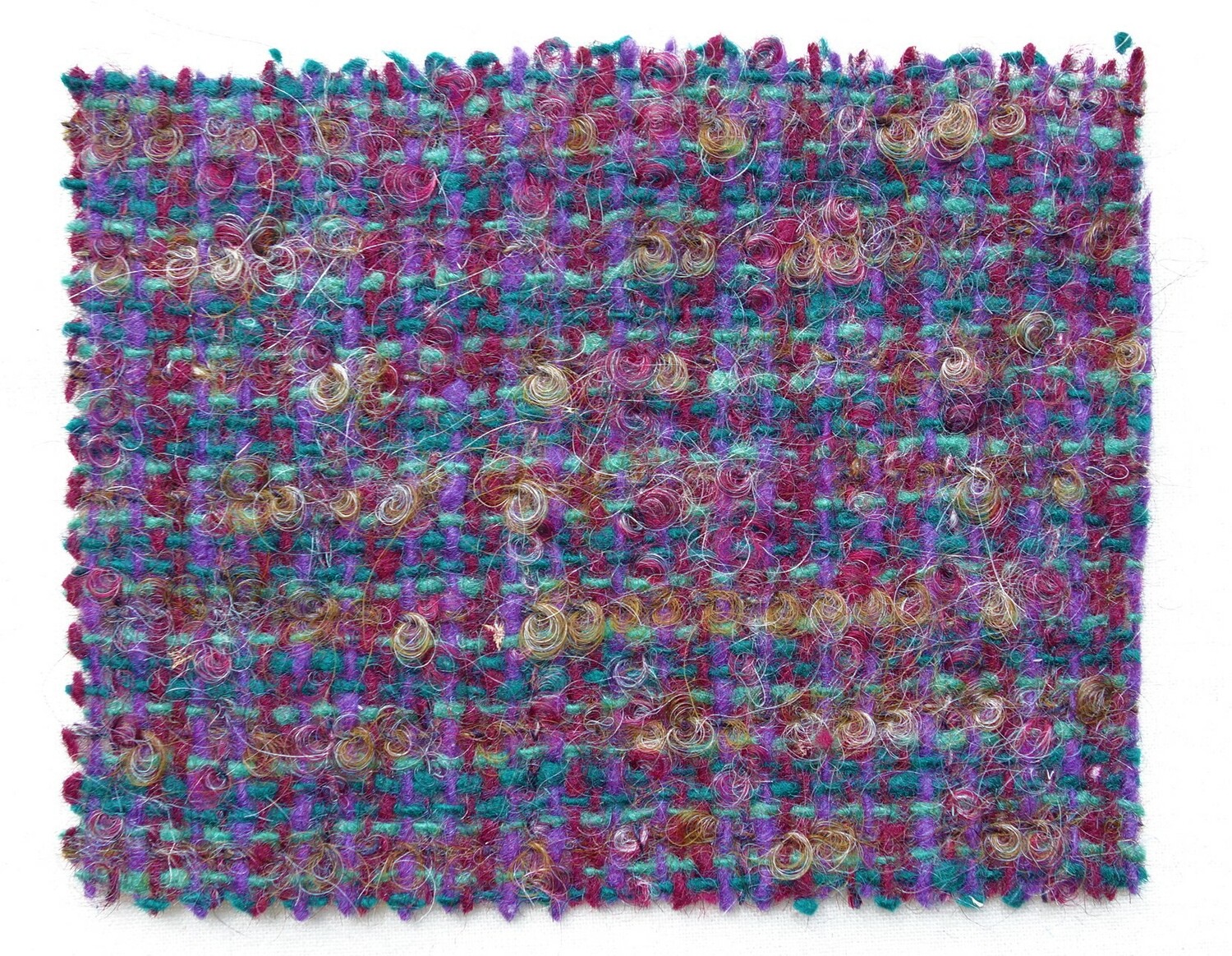 Woven sample with a tweedy check in dark blue, green and dark red bouclé yarns, Europe, 20th century (TRC 2021.1580d).
The reference collection is currently divided as follows. The sequencing below is based on production stages and uses of the textiles.
- Fibres (animal, vegetable and mineral forms, raw and prepared forms)
- Spinning (spinning, splicing; tools - mainly different types of drop spindles and distaffs, rather than a range of spindle and spinning wheels)
- Threads (organic, inorganic, metal, single, plied, cords, etc)
- Dyes (organic/natural dye stuffs, basic mordants, artificial, synthetic forms, etc)
- Dyeing (direct, indirect, resist, burnout, combinations, etc)
- Weaves (plain, twill, tapestry, leno, supplementary warps or wefts, damask, brocade, velvet, compound, double weaves, selvedges, etc)
- Non-woven (felt, knotted, looped, netted, tulle, braids)
- Non-woven: leather (animal, bird,, fish) and leather substitutes
- Hand embroidery (hand decorative stitching, as well as appliqué, patchwork, quilting)
- Machine embroidery (machine decorative stitching, as well as machine appliqué, patchwork, quilting)
- Printing (direct, resist, discharge, combination; block, plate, roller, screen, transfer, etc)
- Hand made lace (bobbin, needle, crochet, knitting, tatting, Tenerife, etc, and related tools)
- Machine made lace (including chemical laces)
- Hand sewing (needles, pins, cases, thimbles, shears, scissors, sewing equipment in general)
- Mending and darning (hand mending, darning, patching, and related tools)
- Beads and applied items (beads, bracteates, chains, coins, seeds, shells, etc)
- Fastenings (buttons, toggles, zips, etc)
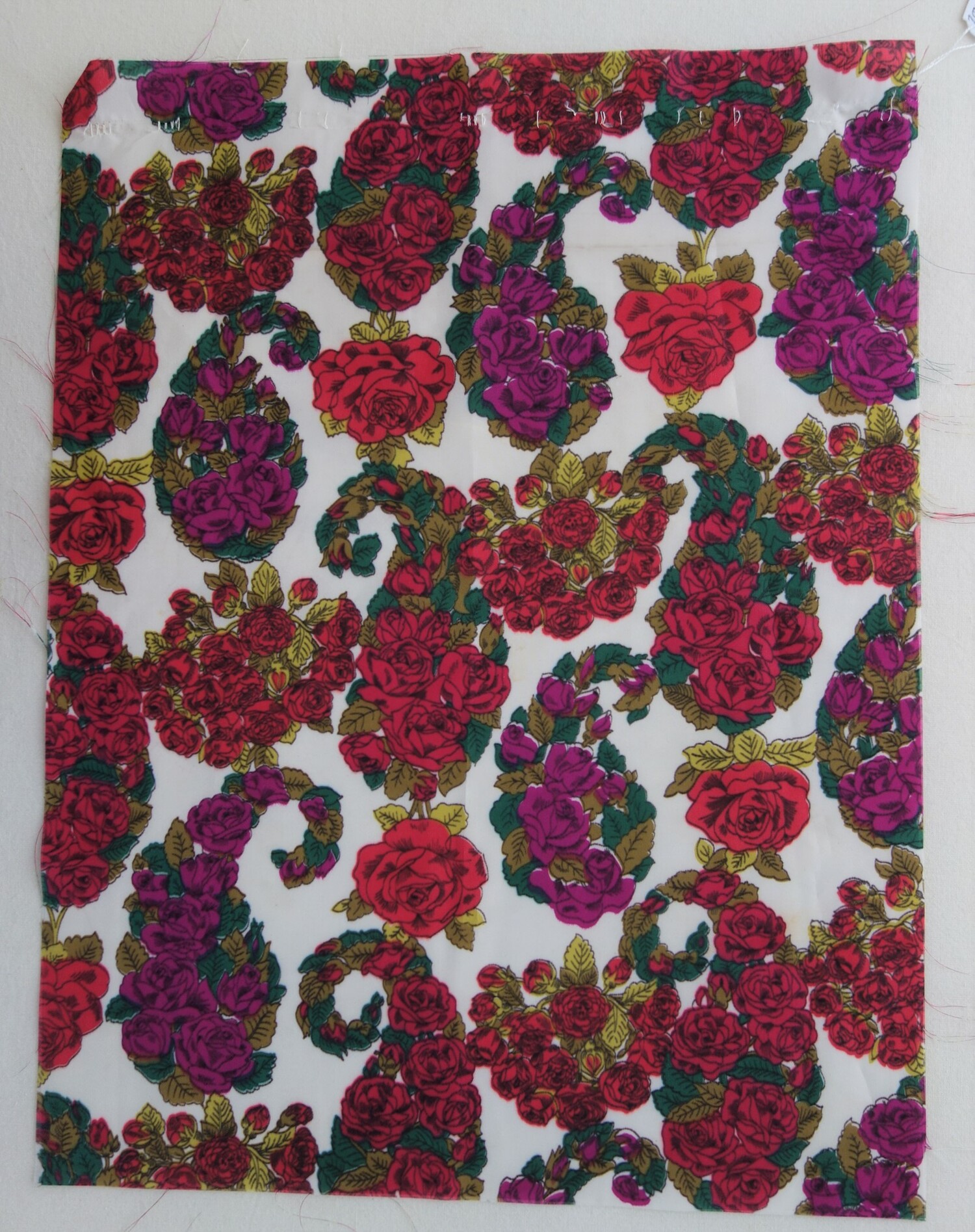 Printed cloth sample with paisley motifs, European,1960s (TRC 2020.2384).The basic definition of weave types is based on Dorothy Burnham, Warp and Weft (1980, Toronto: ROM), which is a simplified version of the French, CIETA definition of weaves, etc. The textile samples range in size from about 5 x 5 cm to about 40 x 40 cm. The main exception are the lace samples that are often narrow, but up to 50 cm in length. They are all stored flat in acid-free boxes.
In some cases we have arranged the samples according to their structure, so, for example, twill weaves are together in one box. On other occasions samples have been arranged according to which decades they belong to or by type of design. So typical 1950s roller printed forms are together, or there is a box of Japanese textile samples and another for Japanese-style textile samples so that the differences between these two forms of patterning can be more easily understood when placed side by side.
Various individuals and groups have offered to help with refining the catalogue and collection, so Alice van Duijnen (a hand weaver and knitting fan) is working on the weave and hand knitting sections, while the OIDFA Nederlands, a Dutch lace group, is going to come at regular intervals to help with detailed descriptions of the hand made lace section. I am working on developing the hand and machine embroideries definitions and categories. We currently need help with fibres, dyes, and prints!
As for buttons and fastenings in general, well, I suspect there will no end to that sub-section! But we will take building up this part of the TRC’s diverse facilities, step by step, or should it be textile by textile?
Gillian Vogelsang-Eastwood, 5 June 2023