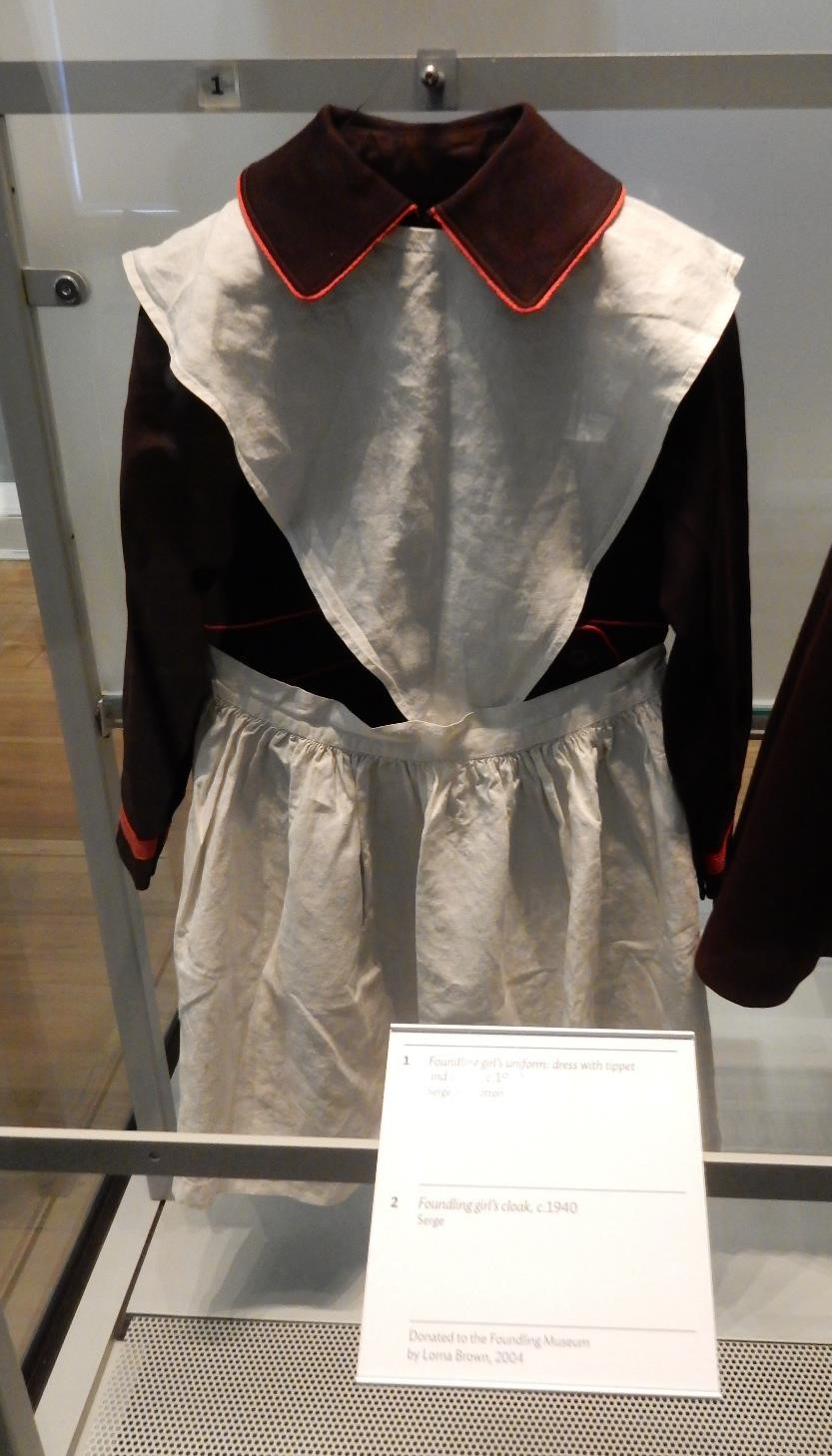
 Outfit for an orphan girl, early 20th century, Foundling Museum, London.The Foundling Museum in London is a fascinating piece of social history. This compact museum records the history of orphans and of those who tried to help them. The story begins in 1741, when the Foundling Hospital (think ‘hospital’ in terms of ‘hospitality’, not medical treatment) was established in Blooomsbury, London, to care for abandoned and neglected children. The orphanage was in operation until 1924, and the building was demolished in 1926. The orphans were rehoused outside of London. The Museum is housed in another building, not far from the original premises, at Brunswick Square.
The displays include oral histories, paintings (William Hogarth was a supporter of the Hospital) and other art works. The latter includes a moving piece made in 2012 by Emma Middleton, and deals with responses from teachers to the orphans’ uniforms. Called “Labelled”, it features a row of pegs on which hang identical white cotton school shirts, each with a red stitched label. The labels record sentences the orphans were told in school: “I hate you”, “If you can’t bring a pencil with you, don’t come”, “You are stupid”. Nearby are two brown serge childrens’ uniforms: a dress and white apron and bonnet for girls; a black necktie, white shirt, red wool waistcoat, trousers and cap for boys. The example on display dates to the twentieth century.
This is not the only textile display in the museum. The museum houses a collection of over 5000 textile pieces, including a few complete baby clothes, swatches, ribbons and embroidery. This is Britain’s largest collection of textiles worn by ordinary working people in the eighteenth century.
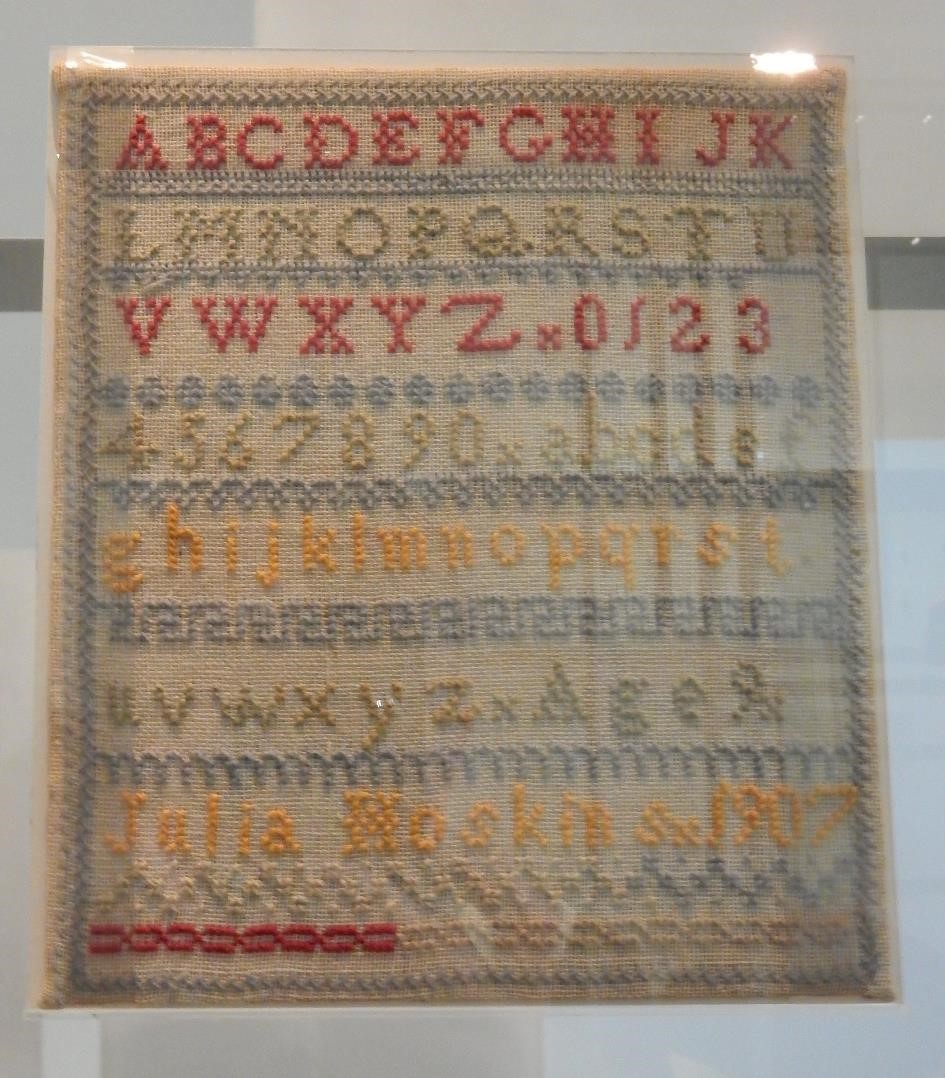 Sampler made by one of the orphan girls in the Foundling Hospital, dated 1907.It came about because every baby given to the Hospital was required to have an identifying token. This token was unique for each infant and could be used later if a relative wanted to reclaim the child. The hundreds of tokens on display are sometimes quirky (e.g., a small pot of rouge, a pair of opera glasses) and often heart breaking (for example, a heart cut from red wool). Tokens included playing cards, coins, jewellery, and in at least one case, a hairpin (given with a baby who, when he turned eleven, was apprenticed to a needle maker).
By far the most common token was a piece of cloth, sometimes personalized with embroidery. Professor John Styles (University of Hertfordshire) has written a fascinating book on these textile tokens, most of which are moderately expensive (for the time) printed cottons and linens. The swatches show how popular printed cloth was, after the dark wool that had clothed previous generations. But there’s more: each baby also had an admittance form which described the infant’s clothes. Professor Styles found over forty different names for fabrics in the lists from 1740 to 1770. The names range from the familiar (calico, flannel, satin, gingham) to the strange (susy, calamanco, fustian). These admittance forms are an important source of information about eighteenth century words for textiles. While not all the textile tokens are on display, the Foundling Museum is well worth a visit for anyone with an interest in textiles.
Shelley Anderson, Wednesday 14th March 2018