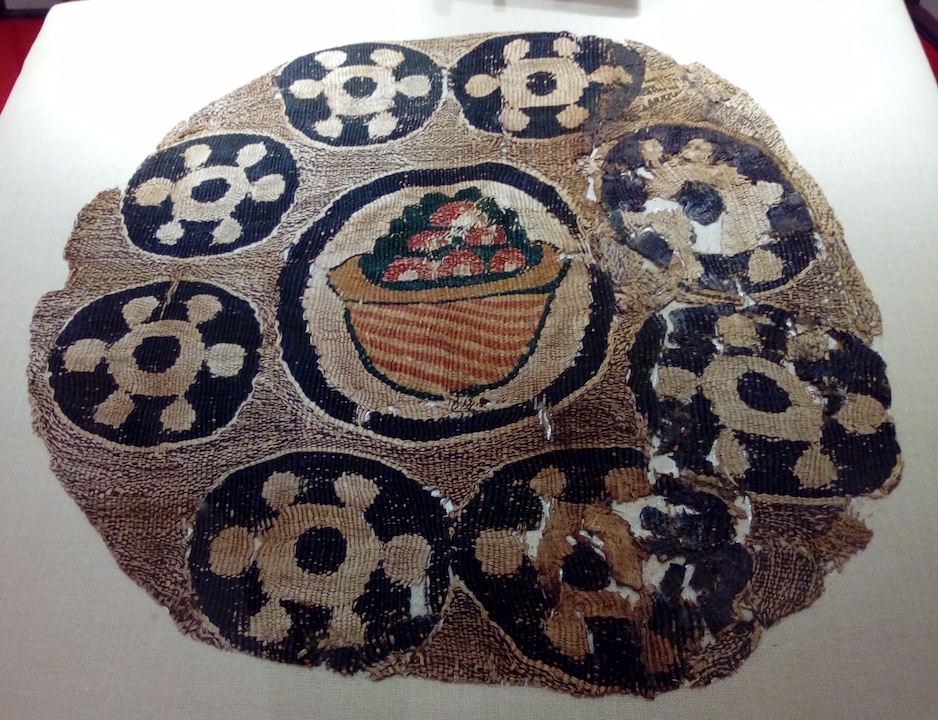
 Coptic medallion of linen and wool, tapestry weave, 6th-7th century, Museo Nazionale di Ravenna.On Sunday, 26th January 2020, Shelley Anderson wrote:
Ravenna, Italy, is better known for its Byzantine mosaics than it is for its textile collections. But during a recent visit I saw some beautiful textiles. The first collection was in the Museo Nazionale di Ravenna, housed in a former monastery next to the Basilica of San Vitale. This museum is home to a large collection of Coptic textiles. The display rotates regularly, but some current pieces include a lovely tunic band showing the birth of Aphrodite (7th-8th centuries CE), and a wider decorative band (7th century CE) of pomegranates and leaves. There was also a large Coptic medallion depicting flowers and fruit (6th to 7th centuries CE), made in a tapestry weave from wool and linen. Next to this was a case displaying, again in a linen and wool tapestry weave, two long bands showing a warrior saint (7th to 8th centuries CE).
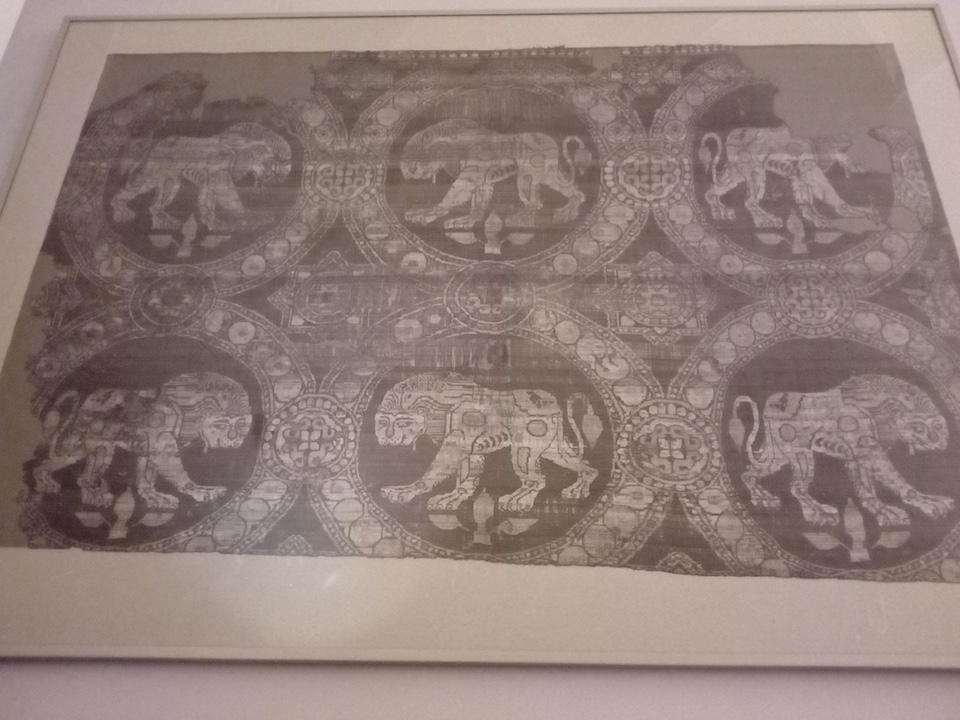 Silk textile, Byzantine, with lions within roundels, 9th-10th century, found in the coffin of Saint Julian, a fourth century Christian martyr, whose remains were kept in the church of San Giuliano in Rimini. Museo Nazionale di Ravenna.All of the Coptic textiles were given to the museum in 1902 by Emile Guimet, founder of the Guimet Museum of Asian Art in Paris. The museum also displays some interesting ecclesiastical textiles, from the collection of the Camaldolese monks. These were much larger pieces of silk, mostly of Byzantine manufacture. The first has a beautiful pattern of lions inside roundels (three-weft yarn samite), while the second was a red mantle. Both were dated around the 9th-10th centuries.
They were found, along with other textiles, in the coffin of Saint Julian, a fourth century Christian martyr, whose remains were kept in the church of San Giuliano in nearby Rimini.
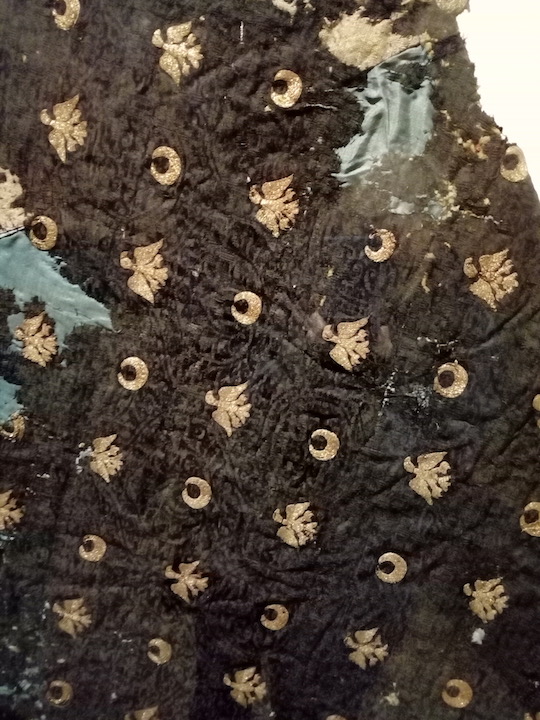 Fragment of a purple coloured silk mantle described as the Planet of Giovanni Angelopte (Giovanni ‘Angel tongued’, who was bishop from 477 to 494 CE). Archiepiscopal Museum, Ravenna.
Anyone interested in ecclesiastical garments needs to visit another nearby museum, the Archiepiscopal Museum, in the Bishop’s former Palace. While there are only a few textiles among the Roman statues and famous 6th century ivory throne, the liturgical vestments on display are stunning.
In particular there is a purple coloured silk mantle described as the Planet of Giovanni Angelopte (Giovanni ‘Angel tongued’, who was bishop from 477 to 494 CE). This has a height of 156 cm, and while it is not in the most complete condition, the delicate gold-thread pattern of birds and crescent moons is striking. There are also more modern vestments on display, with exquisite embroidery. The garments reflect the skill and power that Ravenna enjoyed as the once-capital of the Western Roman Empire.