On Wednesday, 1st April 2020, TRC volunteer Heidi-Elena Stanionyte (Estonia), writes:
Regional costumes can be considered as an the important part of many world cultures. In the Baltic countries, Estonia has a significant range of costumes from different regions, which are also known as parish. A well-known region is Kadrina parish, which is situated in the northern part of the country. A characteristic feature of its regional costume is a blouse with embroidered decoration (called ‘’käised” in Estonian), which covers the front and the collar.
Kadrina embroidered blouses are worn by married and unmarried women, together with a simple sleeveless shirt. The blouses are made of linen, which is a material that was widely used in other parishes around Estonia. Typically, the embroidery is worked with bold colours, especially reds, blues and greens.
The Kadrina blouse collection in the Estonian National Museum houses many examples of these blouses, with rich floral embroidery worked with silk, cotton or woollen thread. The oldest examples date to the late seventeenth century.
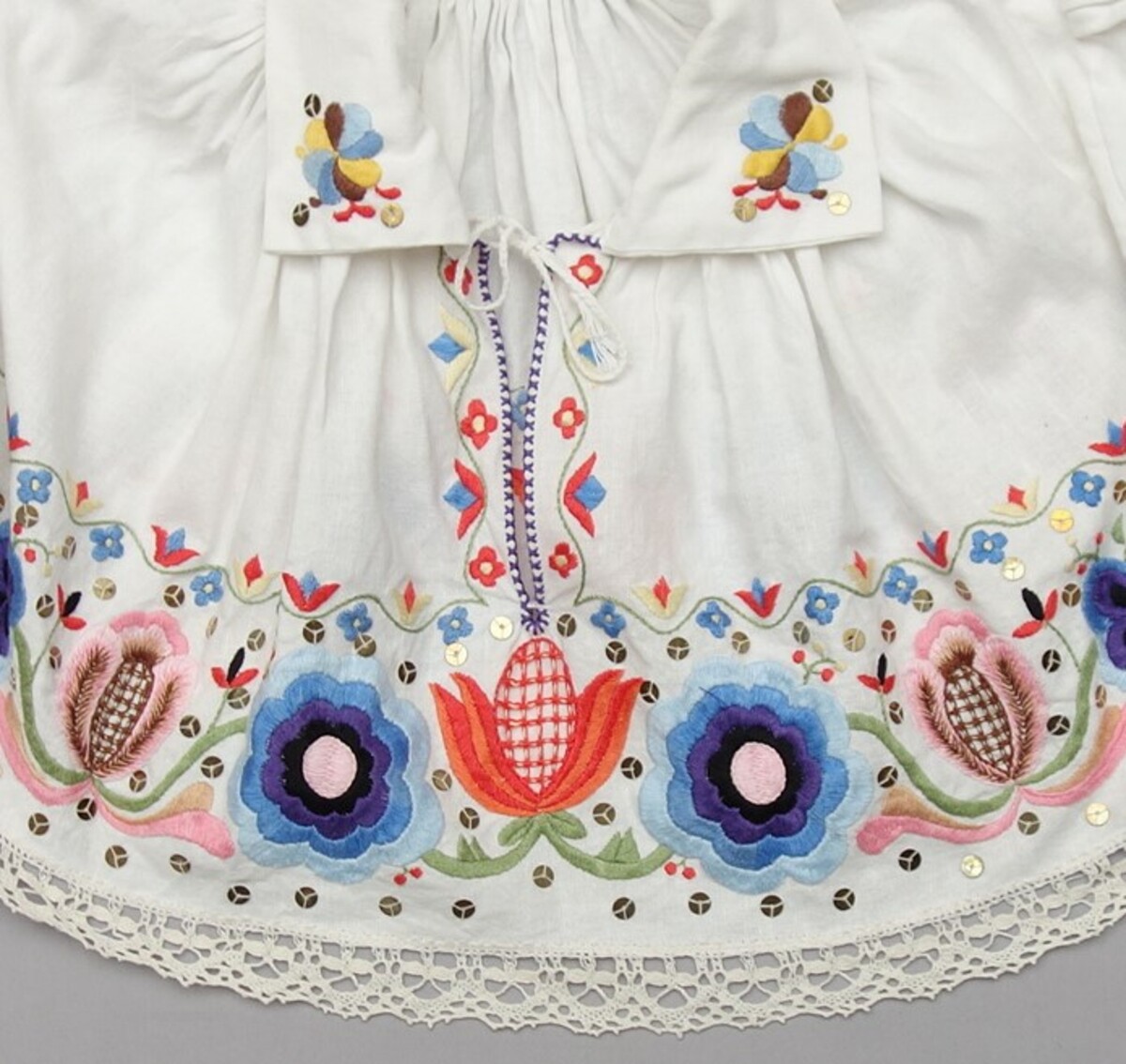 Detail of an embroidered blouse from the Kadrina parish, northern Estonia, early 21st century (TRC 2020.0010).
The history of this form of embroidery goes back to the times when the Baltic Germans ruled Estonia. Local women learned the technics of embroidery from the Germans. They appreciated this form of exotic embroidery. As the time passed, Estonian handicraft embraced the foreign influences and incorporated them into their own traditions. For example, golden sequins were added, and this extra feature is seen on a blouse now housed in the TRC Collection (TRC 2020.0010), and illustrated here.