In order to celebrate Easter in these very strange times we are putting some special embroidery charts online. All of these designs date from the mid-20th century or earlier and come from various parts of Palestine. Please feel free to use them. Enjoy!
 The ‘airy fairy’ (iruq al-nafnuf), ‘rose bud’ or ‘orange blossom’ motif from the Beit Dajan region of southern Palestine.
Many of the names of the designs were taken from objects associated with daily life. The original embroideries were made on locally woven linen (19th century) and, in the 20th century, on even-weave cotton cloth (between 11-14 threads per cm). For the embroidery threads, silk floss yarn dyed with plant dyes such as madder (red) and indigo (blue) was initially used, but by the 1890’s (artificial) aniline dyed yarns became more and more popular. In the 20th century more and more synthetic dyes were used
By the 1920’s mercerized perlé cotton thread had become popular and it is still used to the present day in some regions. Other people use mercerized ‘satin’ yarn, such as that produced by DMC.
The embroideries were all worked in cross stitch, apart from the Tall Palm example (second chart), which was made using a line of yarn that was covered (trammed) with small tent stitches.
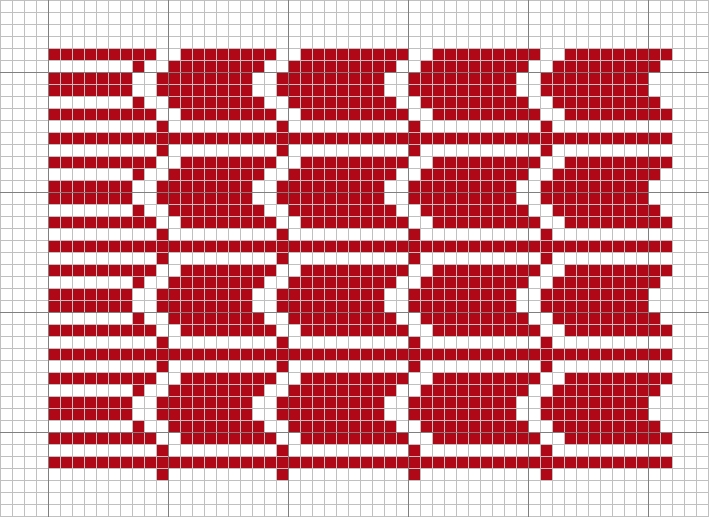 Chart of a ‘Tall Palm’ or ‘Ears of wheat’ motif from the Ramallah region.
Good Friday
Various motifs used for the front chest panel (qaba) of women’s dresses from the Hebron region. ‘Teeth necklace’ (qeladet snan) motif.
 A version of the ‘barbed wire fence’ (siaya) motif.
 A version of the ‘barbed wire fence’ (siaya) motif.
 A version of the feather branch design.
 A version of the ‘tile of Hebron’ motif, which has elements of the feather branch motif.
Saturday
These embroidery designs come from the Ramallah region and were used on women’s dresses. The first design, now called ‘Crowns’, is based on the music stands printed in a DMC embroidery book!
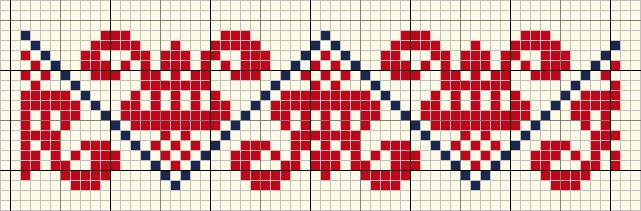 ‘Crowns’ motif.
 ‘Heart’ (qalb) motif.
 'Wide open eye' (ayn kabira) motif.
 ‘Moon’ or ‘flower’ motif
Easter Sunday
Two cross stitch designs associated with garments from Bethlehem and Gaza:
 Stylised cross from a Bethlehem dress.
 Embroidery chart for a cross and floral design from the Gaza region.
Easter Monday
Some cross stitch designs associated with garments from the Ramallah region. The town of Ramallah used to be famous for the production of large cauliflowers and carnations.
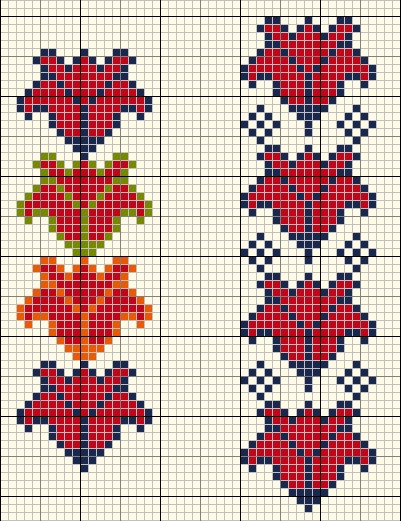 Two versions of the cauliflower motif from the Ramallah area.
 Charts of various forms of the carnation motif from the Ramallah area. Left to right: carnation (qrunful) or pretty carnation; carnation branch (iruq al-qrunful); carnation (qrunful), and another version of carnation (qrunful).
Some extra designs should you feel inspired
 From left to right: ‘moon of Bethlehem’ (qamar Beit Lahem); ‘apple branch’ (iruq el-tuffah) and 'tiles of Bethlehem’ (balat Beit Lahem).
 ‘Moon and flowers’ motif (Hebron)
‘ 'Carnation branch’ (iruq al-qrunful) motif (Hebron).
 A geometric design from the Galilee region.
 A geometric design from the Galilee region, based on amulets or triangles (hujub).