• F2
  • F4
  • F3
  • F1

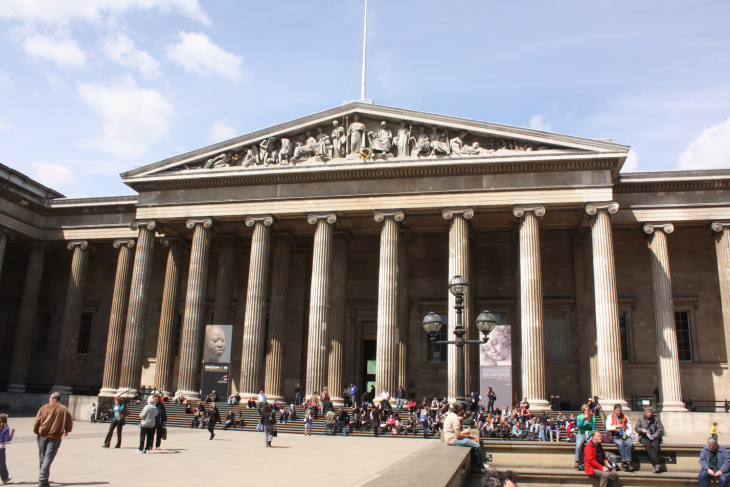
A series of silk, 17th century Vrindavani Vastra textiles, now on display in the British Museum, London.A series of silk, 17th century Vrindavani Vastra textiles, now on display in the British Museum, London.Last Thursday, March 3rd, and just before the official book launch that afternoon of Gillian's Encyclopedia of Embroidery from the Arab World in the Petrie Museum in Londonwe went to see a special exhibition in the British Museum about a particular type of figured woven textile from northeastern India. The main exhibit is a truly enormous piece of material of some nine metres long and more than two metres wide. It  is made up of twelve strips that are sewn together and are topped with three bands of Chinese damask and one band of Chinese brocade. The panels are made of silk and ornamented with the most wonderful illustrations, captions and texts, woven into the material. They date back to the late seventeenth century and derive from Assam in northeastern India. The panels were originally used and exhibited independently. but in later years were taken to Tibet, and eventually transported to Britain. This happened in the early 20th century after the march upon Lhasa by Francis Younghusband (1904-1905), which was organised in order to counter the perceived spread of Russian influence in the region. Perceval Landon was the war correspondent of The Times during the expedition. He apparently got hold of the nine metres long piece of material and had it sent and eventually donated to the British Museum. The same man, some years previously and during the Boer War, proudly posed for a photograph in South Africa together with the author and Nobel-Prize winner Rudyard Kipling !

Fragment from the Vrindavani Vastra on display in the British Museum, 2016, showing the snake demon Kaliya being defeated by Krishna.Fragment from the Vrindavani Vastra on display in the British Museum, 2016, showing the snake demon Kaliya being defeated by Krishna.The panels illlustrate the life of Krishna, one of the most popular deities of India and an incarnation of one of the main gods, Vishnu. The type of the illustrated panels is generally called Vrindavani Vastra, or the cloth of Vrindavan, named after the region in northern India where Krishna is thought to have grown up. The panels show various scenes from the life of the young Krishna. As a true Hercules, he defeated a whole series of demons, including a crocodile, a multi-headed serpent (Kaliya) and an ill-tempered crane. But there are also representations of the naughty Krishna dancing with young shepherdesses (the gopis) and hiding their clothes in a tree. Many of these episodes from Krishna's life are still being enacted all over northern India, at places where Krishna is especially venerated. This happens during the Ras Lila festival in late October / early November. It is actually very well possible that the panels of the exhibited Vrindavani Vastra were shown at this festival in Assam. But there are also representations of the other incarnations (avataras) of Vishnu, such as Rama, the hero from the famous epic of the Ramayana; the turtle who carries the world on his shell; the fish (matsya) that saved the first human meaning (Manu) in a true Noah-like fashion, and others. 

The exhibition also includes a beautiful eighteenth century coat from India, on loan from the Chepstow Museum in southeastern Wales. The coat is lined with a Vrindavani Vastra. It also shows scenes from Krishna's life, including his playing with the gopis.

The exhibition in the British Museum can be visited until 15 August. The exhibition is curatored by Richard Blurton, senior curator of the South Asia Collections of the BM, whom, it so happens, I first met, many years ago, at the British excavations of the old town of Kandahar in southern Afghanistan. Richard also wrote a small booklet to accompany this wonderful exhibition.

Willem Vogelsang, 5 March 2016

Karin Scheper's sample of Palestinian embroidery, made during the TRC workshop and finished at home.Karin Scheper's sample of Palestinian embroidery, made during the TRC workshop and finished at home.In the latest edition of the monthly TRC Wednesday morning workshop series, on the 24th of February, no less than twelve persons attended the workshop on Palestinian embroidery. Gillian (Vogelsang-Eastwood) introduced us to this specific needlework tradition with an informative and well illustrated PowerPoint, which provided a lot of historical background information and gave us insight in the regional varieties. In addition, there were plenty examples of textiles that we could touch and scrutinize, before we started on the making of our own samples. The tables with the laid out pieces of cloth, threads and designs were set amidst dressed mannequins, for further inspiration. As in the other workshops that I attended so far, participants could choose between the levels fairly simple, somewhat experienced and advanced, and all the materials to make our own samples were well prepared. For me, the goal of practicing is to obtain a better understanding of the materials and techniques, to try and learn things I didn’t know before, and quite simply to enjoy the textile artifacts. The easy-going atmosphere makes it all the more enjoyable, and so does the stimulating presence of the real artifacts and the presence of knowledge (and, as a bonus, we had the possibility of a sneak preview of the Encyclopedia of Embroidery from the Arab World!).

Karin Scheper, 29 February 2016

Women wearing red hakama at Shinto shrineWomen wearing red hakama at Shinto shrineA few days ago the TRC was able to acquire a small collection of Japanese garments that used to belong to Dr Erika de Poorter, who was a specialist of the Japanese Noh theatre at Leiden University. Among the various kimonos, there was a special item, namely a divided skirt (hakama) in dark red silk. Hakama are still worn by men as part of the traditional outfit for special and formal occasions; the red cloth of our hakama, however, suggests that the trousers were made for a woman. Hakama are worn by musicians and stage attendants of the Noh theatre, but this is still very much a man’s world and it is not likely that Erika picked up her hakama in this context.

But women do wear hakama on certain occasions. Miko (Shinto shrine maidens) wear the same outfit as their male counterparts, but in different colours. Women who practice traditional martial arts, such as kendo and archery, also wear hakama, but usually in the ‘male’ grey, black or dark blue. Finally, hakama are worn by women at university graduation ceremonies, often with Victorian-style booties. When compulsory education was introduced in Japan at the end of the 19th century, boys were soon required to wear military-style uniforms. Girls, however, still wore kimono. Because this was far from practical, the hakama was introduced for them: it looked like a skirt, but offered pant-like functionality. The graduation hakama is a nostalgic reminder of these early days of female education.Female graduates wearing hakama, JapanFemale graduates wearing hakama, Japan

Anna Beerens, 1 February 2016


Murtaza Ahmadi with his Messi T-shirt. Photograph by his brother.Murtaza Ahmadi with his Messi T-shirt. Photograph by his brother.Believe it or not, I know just about nothing about football, apart from the scandals surounding this Swiss bloke and his cronies who seem to have made an awful lot of money out of a simple game. But I do follow the news about Afghanistan and this week there was something in the media that was really nice. A young boy in Ghazni province, not exactly the place to go on holiday, was photographed with a plastic bag as a T-shirt with written on it the name of Messi. Because of the Afghan boy I now know that Messi is a famous football player; I have no idea where and how, and when, but that does not matter. For the Afghan lad Messi is a star, and he is very proud of showing Messi's name. I think the boy is the real star. I understand he is only five years old. His 15-year old brother made him the T-shirt with the name of Messi written on it with a marker pen. Then the brother took a photograph and put it on Facebook. That was some two weeks ago. And that photograph went, as it is called, ' viral'. In the end it was the boy's uncle that recognised the boy. The uncle lives in Australia, another reminder of the Afghan diaspora and the fate of the Afghan people. It is a smile, in an otherwise desperate situation.

Willem Vogelsang, 31 January 2016

Embroidered Qing-period curtain, with postage stamp inserted. Taiwan, modern.Embroidered Qing-period curtain, with postage stamp inserted. Taiwan, modern.This morning I had the honour to welcome the new visiting professor in Taiwan Studies to the International Institute for Asian Studies, Leiden. We had a long chat, and at the end my Taiwanese guest and his wife gave me some little presents. When I opened one of them, it happened to be a booklet with a long and folded sheet of thin, gold painted paper, into which five postage stamps are marked out, dated to 2013. The sheet carries a reproduction of a Qing period curtain that is now housed in the National Museum of History, Taipei. The curtain is decorated with embroidery showing flowers and birds, against a background of rich red silk with more flowers, birds, grass, trees, clouds, rocks and other delicately embroidered motifs. It is regarded, according to the accompanying text, as one of the Qing Dynasty's greatest pieces of embroidered art.

This curtain is in reality almost five metres long. The composition centers on an eye-catching peacock. Called "Ode to the Great Earth", the theme of the curtain offers a colourful and beautiful vista of blooming flowers and brightly coloured birds, heralding the arrival of spring. Indeed, a worthy subject for embroidery, and for stamps!

Willem Vogelsang, 22 January 2016

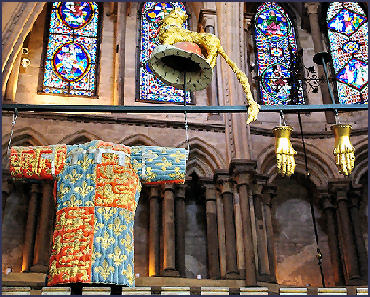
Chester cathedral, embroidered hearse clothChester cathedral, embroidered hearse clothWillem and I are in Chester, England, for a few days and could not resist going to the Cathedral, among others to see if they had any embroideries. They are there, but you need to search for them! There is a late 19th century central altar frontal (high altar) made from a cream damask ground with an art nouveau style design of three trees with intertwining grape vines, leaves and bunches of grapes, flanked by small bushes, possibly olive ones, but that was not clear. Tucked away in one corner (see photograph) is a 19th century hearse cloth with a blue silk damask ground, embroidered with couched gold thread (passings). The design is hard to see, as it has been placed on a wooden roller inside a wooden case, but there are bishop's crosier with what looks like a W alternating with lilies, as well as coats of arms.

In another part of the Cathedral there is an appliqué dedicated to the United Nations that is a commissoned piece dating to AD 2000. For the Christmas period there was an appliqué panel depicting the Chester Mystery Plays, a series of medieval plays based upon the life and death of Jesus Christ. In this case, it was the Chester series, depicted with buildings from the centre of the city. A bit of fun, and nicely done. There were also several large-scale, appliqué banners, depicting Mary and Child, as well as the the Creation (stars, birds and fishes).

Finally, in a chapel dedicated to the Cheshire regiments, there are a number of flags, with regimental honours. Some of the flags look as if they date from the early 19th century and were embroidered with the names of various battles. But they were so high up it was difficult to be sure.

But what about vestments? Alas nothing was on view, the various people we asked said: yes, there are vestments, but they were not sure what, where, or whether they were embroidered. A cathedral with the history of Chester's should have embroideries and vestments dating back several centuries, if not longer. I will be persuing this and trying to find out what they have. My curiosity has been piqued!! Chester beware.

Gillian Vogelsang, 2 January 2016

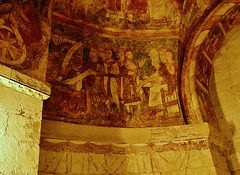
Murals in the 4th century AD Romulus temple, Rome, representing long line of wall curtains. 13th century AD.Murals in the 4th century AD Romulus temple, Rome, representing long line of wall curtains. 13th century AD.Never thought I would ever get particularly interested in something as mundane as curtains, but right now, spending a week in Rome with Gillian, I am afraid I am starting to see curtains everywhere, or to be more precise, what I see all the time are paintings of curtains. Perhaps the moment has come to go back to Leiden. Anyhow, it all started some days ago when I saw some wall paintings, or at least fragments thereof, in the circular temple of Romulus (nota bene: not the Romulus of Remus fame, but an early 4th century AD son of a Roman emperor) at the Forum Romanum. The temple, as so many other ancient buildings in Rome, was later converted into (part of) a church, namely the basilica of Santi Cosma e Damiano. The frescoes I am alluding to once ran all along the lower part of the inside of the wall of the building, and represent a continuous line of curtains. The frescoes allegedly date to the thirteenth century, to the time of Pope Urbanus IV (1261-1264). The curtains, as can be seen from the photograph, are depicted as being tied at regular intervals around a (painted) beam above (hence the draped fold lines). The top of the depicted curtain has a thick band that is bejewelled. From this band hangs the wide curtain itself. The ground material of the curtain is in white, with three wide horizontal bands alternating with quatrefoils of various sizes.

With these curtains in mind, we visited the next morning the Sistine Chapel (together with tens of thousands of others, all at the same time, but at least we did not get a selfie-stick poked into our eyes). But instead of being awestruck again by the magnificent frescoes along the upper part of the walls and Michelangelo's masterpiece on the ceiling, I was suddenly made aware of ...... a line of curtains painted along the lower tier of the chapel's walls. I had never noticed them before. Did you? Some of them were shown as being draped, others were not. These paintings, I was told, date to the late fifteenth century and the time of Pope Sixtus IV. Most of them are damask-like with silver or gold thread decoration, others, without the emphasised fold lines, are shown flat with very little drape, imitating velvet.Sistine chapel, Rome, showing paintings of curtains along the walls. Late 15th century.Sistine chapel, Rome, showing paintings of curtains along the walls. Late 15th century.

And yesterday, in the Santa Maria Maggiore, I again saw the same feature, namely, a painted curtain, but this time on a wooden screen in one of the side chapels.

I am quite sure that art historians have written complete libraries on the subject of these paintings of curtains, hence my apologies, but I had never noticed them, although such painted curtains or draperies can probably be found in many other places. But what sort of nutter looks at paintings of curtains when there is so much else to admire? But in any case, what a treasure trove for further research into medieval textiles and their different types of decoration.

Willem Vogelsang, 26 December 2015

On Saturday 19th December there was a Yemeni embroidery workshop at the TRC. Normally these workshops are on the last Wednesday of the month, but because of Christmas it was moved to the Saturday just before we closed for a few weeks over the holiday period (we re-open on the 11th January). This was also an open day at the TRC and literally, the last chance to see the colourful, Yemeni clothing and jewellery exhibition. The workshop was led by myself and consisted of a guide tour of the exhibition about Yemeni embroidered garments and jewellery, and concentrated on the decorative needlework aspects. This was then followed by the participants of the workshop trying out a range of embroidery stitches and motifs all based on blanket and chain stitches. All of these forms can be found back in Saudi Arabian and Yemeni garments. The final section of day involved looking at one particular garment and then reproducing various patterns and motifs on black cotton cloth using a thick, white cotton thread. Something that was totally new for the participants. The time went very quickly indeed. The workshop was immediately followed the TRC’s Christmas party (members of the workshop were also invited!), which gave us the chance to relax, talk with good friends, eat good food surrounded by amazing textiles and garments. What a wonderful way to end a very busy year!

Gillian Vogelsang, 20 December 2015

Zoek in TRC website

Contact

Boerhaavelaan 6
2334 EN Leiden.
Tel. +31 (0)6 28830428  
office@trcleiden.org

Het TRC is elke dag geopend tussen 10.00 en 15.00 uur.

facebook 2015 logo detail


instagram vernieuwt uiterlijk en logo


Bankrekening

NL39 INGB 0002 9823 59, t.a.v. Stichting Textile Research Centre.

Financiële giften

Het TRC is afhankelijk van project-financiering en privé-donaties. Al ons werk wordt verricht door vrijwilligers. Ter ondersteuning van de vele activiteiten van het TRC vragen wij U daarom om financiële steun:

Giften kunt U overmaken op bankrekeningnummer (IBAN) NL39 INGB 000 298 2359, t.n.v. Stichting Textile Research Centre. BIC code is: INGBNL2A

U kunt ook, heel simpel, indien u een iDEAL app heeft, de iDEAL-knop hieronder gebruiken en door een bepaald bedrag in te vullen: 


Omdat het TRC officieel is erkend als een Algemeen Nut Beogende Instelling (ANBI), en daarbij ook nog als een Culturele Instelling, zijn particuliere giften voor 125% aftrekbaar van de belasting, en voor bedrijven zelfs voor 150%. Voor meer informatie, klik hier