More and more people are wearing interesting, plain, colourful, funny, gruesome, as well as symbolic face masks as the corona virus situation drags on and on. There are fashion designers producing matching garments and masks, Gothic black forms with lace and feathers, to local groups supporting various charities by making and selling suitable masks. See the recent TRC blog on the variety of face masks.
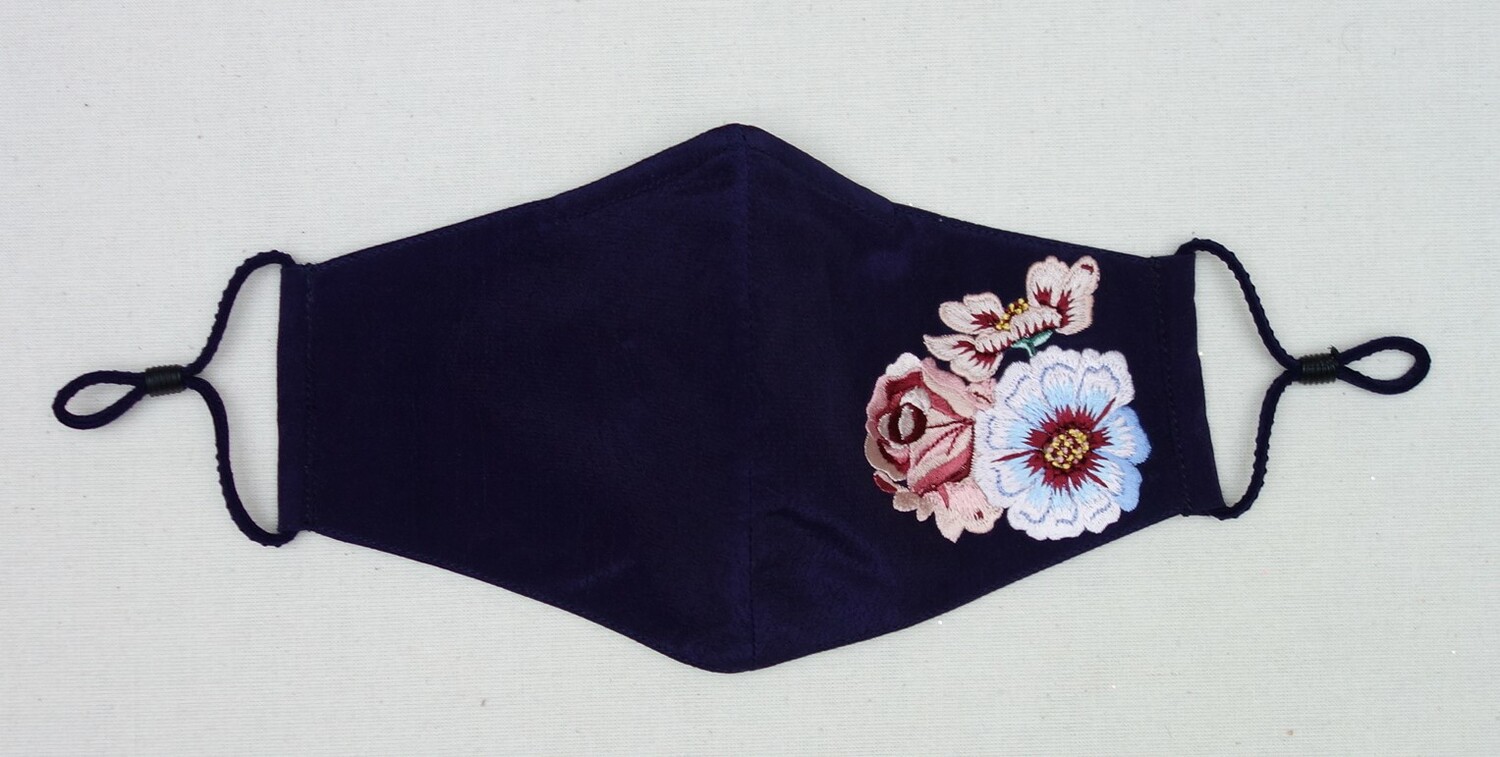 Face mask designed by the firm of Hand&Lock in London, 2020 (TRC 2020.5176a).
Various museums and similar institutes are also making collections of masks, and the TRC is no exception. In fact one of our volunteers, Shelley Anderson, is actively looking and acquiring suitable examples (see a TRC blog, by Shelley Anderson).
A few days ago we were given by Hand&Lock one of their own face masks, in dark blue cloth decorated with a delicate, machine embroidered design of flowers with a storage bag (TRC 2020.5176a-b).
This is not the first time the company has kindly donated items to the TRC collection. They have given us various items over the last five years that reflect their history and work. But who are Hands&Lock and why are they so important to the world of textiles, dress and embroidery?
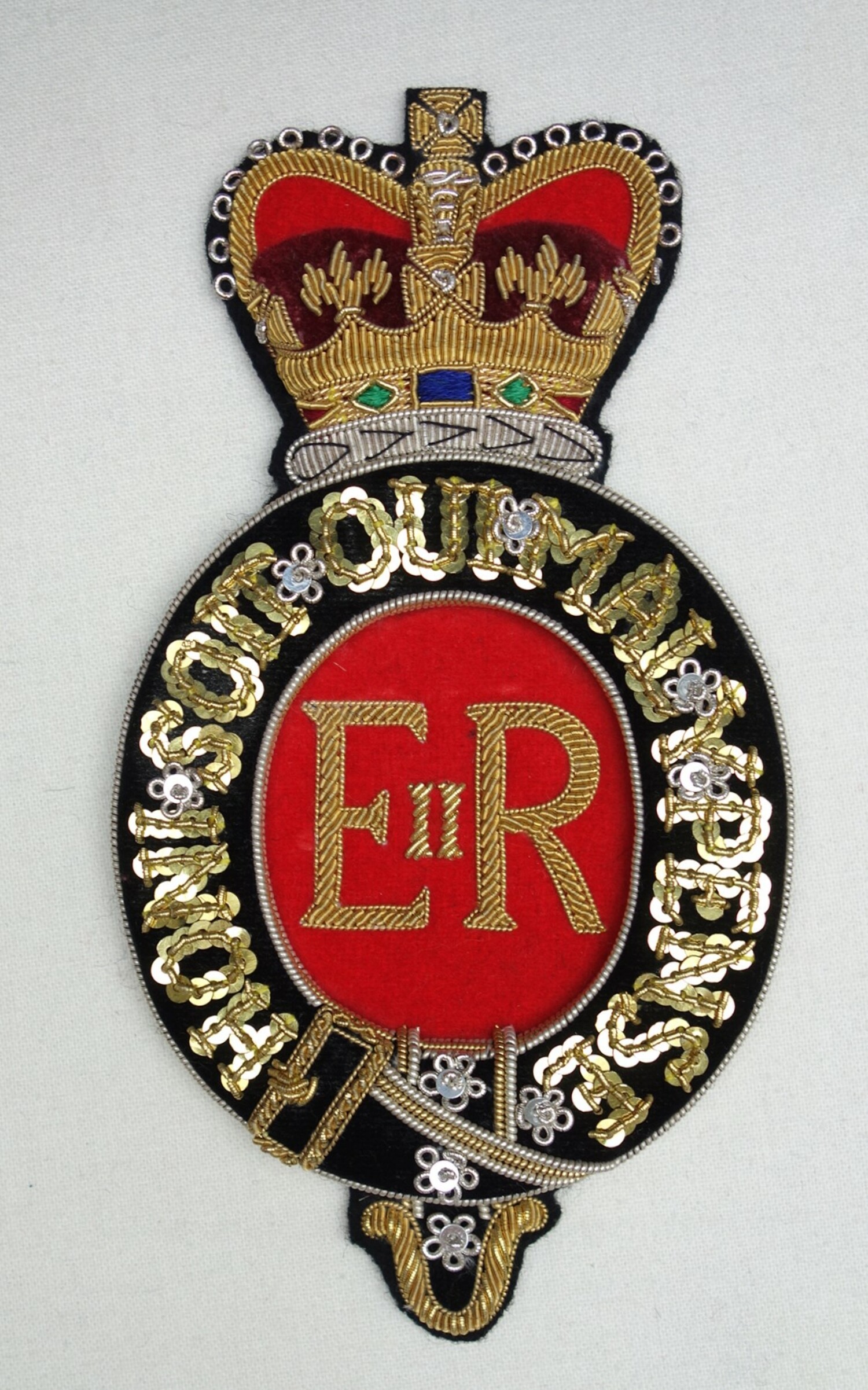 Embroidered insignia for a Royal postillion, produced by Hand&Lock, 2019 (TRC 2019.1808).The company of Hand&Lock is an historic embroidery firm based in London. It was set up in c. 1767 by a Protestant Huguenot refugee from (Catholic) France, who was called M. Hand. He started to produce and sell lace. In this case lace refers to a woven braid made from gold and silver metal thread, not to, for example, a fine bobbin lace (in 2016 Hand&Lock donated to the TRC a sample collection of military laces that they use on a regular basis - see TRC 2016.1897a-x and 2016.1898a-h).
Later, Mr. Hand started to make military badges and uniform accoutrements. The company is still producing this type of hand and machine embroidered items (for a small selection of their cap and pocket badges/patches, see TRC 2017.2708-2017.2714, and TRC 2019.1803 – TRC 2019.1808).
Over the next two hundred years, M. Hand & Co., became well-known as military tailors. In the 1950’s Stanley Lock worked as an embroidery designer at the specialist firm of CE Phipps & Co. In 1956 Stanley Lock bought this company and renamed it S. Lock Ltd. The newly formed couture embroidery house went on to work with couturiers such as Christian Dior, Norman Hartnell and Hardy Amies, and Catherine Walker. The firm worked on gowns for the Queen, Queen Mother and later Princess Diana. The company was subsequently awarded the Royal Warrant in 1972. In 2001, the firms of Hand and Lock joined forces and established the firm of Hand&Lock.
Since then Hand&Lock has worked for and with a wide range of fashion houses, designers, Royal forces, film and theatre groups. More recently they have started various classes teaching different aspects of embroidery.
In 2000 they established the annual Hand&Lock Prize for Embroidery, for people to “showcase their talents and gain vital exposure and experience”. The competition now includes textile artists, interior and accessory designers as well as those working in fashion in order to bring together embroiderers from all over the world.
Gillian Vogelsang, 22 December 2020.