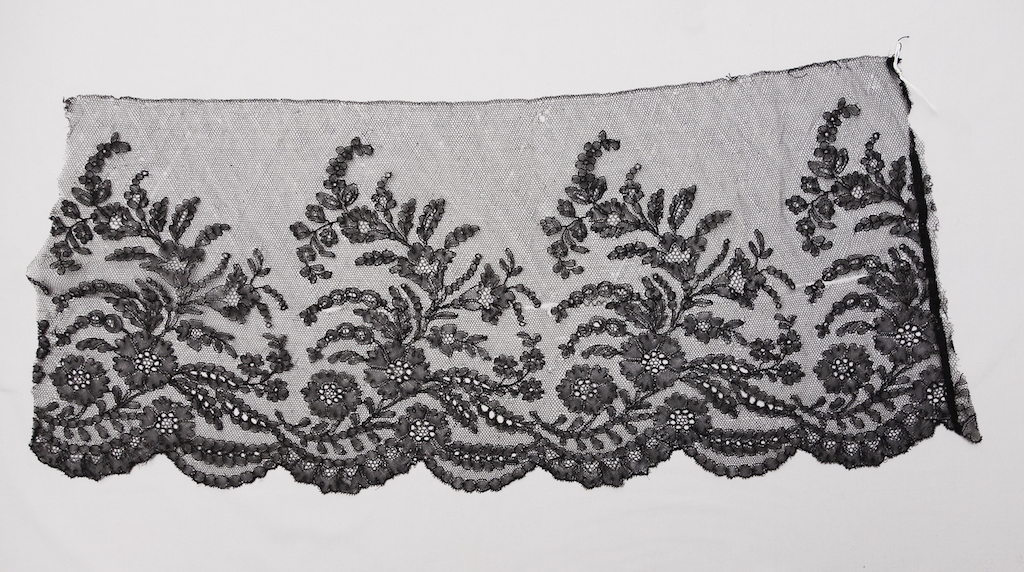
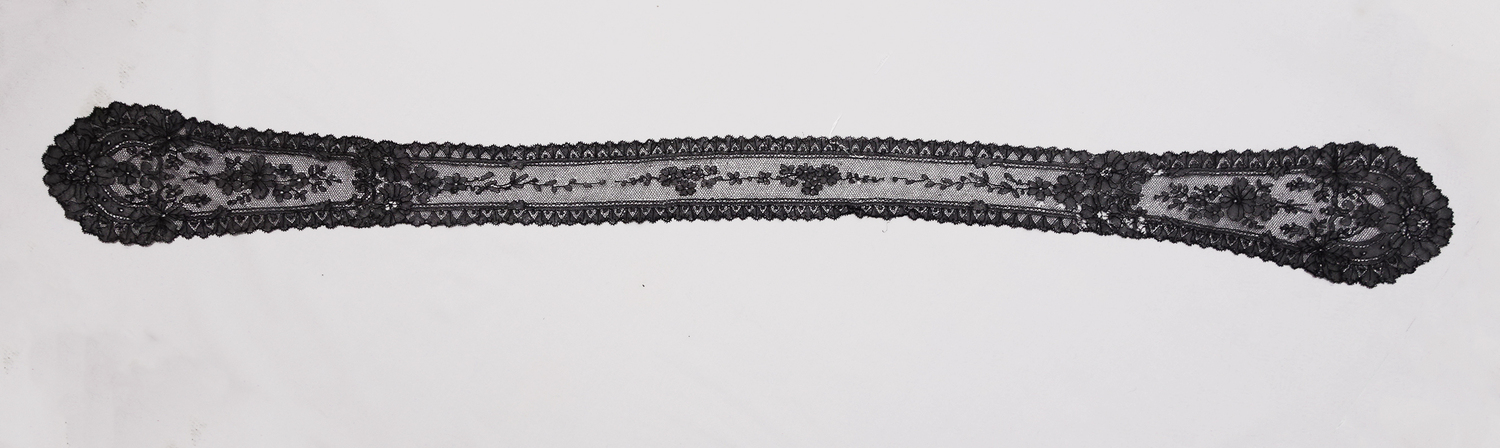
 Chantilly lace skirt flounce (c. 1870s, France; TRC 2021.1903).We have recently been cataloguing a collection of lace given by Styske Wijnsma that includes a range of handmade and machine made lace, with some lovely lace collars. Among the bobbin lace examples there are several pieces of black Chantilly lace from the latter half of the 19th century. Two pieces, in particular, caught my eye, one is a long, deep length that was probably used as a skirt flounce (TRC 2021.1903), the other piece is a lappet (TRC 2021.1902). The latter raises two basic questions, what is Chantilly lace and what is a lappet?
Chantilly lace
Chantilly lace is a form of bobbin lace that dates back to the 17th century and derives its name from the French town of Chantilly, just north of Paris. It became very popular in the mid-18th century and continued to be made and use well into the 19th century. Although it is called Chantilly lace during the 19th century this style of bobbin lace was also being made in Bayeux (France) and in Geraardsbergen (Belgium), and by the end of the century also in Brussels and Ghent.
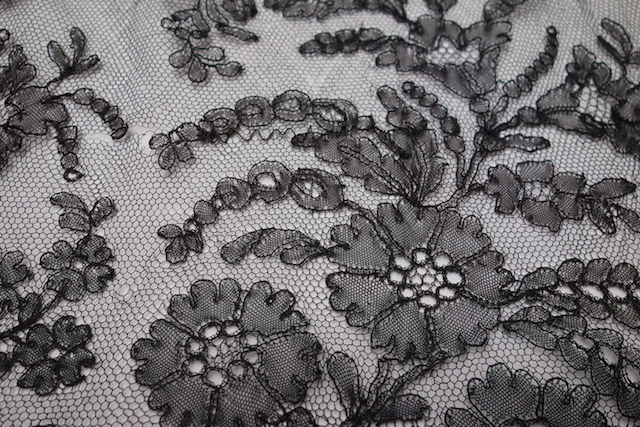 Detail of a Chantilly lace skirt flounce (c. 1870s, France; TRC 2021.1903).Traditional Chantilly lace was normally made out of matt black silk, although sometimes an undyed linen version was produced. There are few 18th century black silk examples surviving and this may be due to the dyes and mordants, used to colour the silk black, which oxidised and rotted the yarns. Modern versions of Chantilly lace tend to be machine made and produced with synthetic yarns.
Handmade Chantilly lace is characterised by having a fine net ground (reseau) in the form of a 6-pointed star for the earlier forms and by the 19th century an hexagonal (Alençon) ground. This form of lace is usually decorated with an intricate pattern of scrolls, branches and flowers that are outlined with a thick floss thread (cordonnet, grenadine).
In 1958 a very popular rock and roll song was released called “Chantilly Lace” which was written by Jiles Perry “the Big Bopper” Richardson, which is about the wearing of black silk lace by a woman and the effects it can have on a man! Click here to listen to the song!
 Chantilly lace lappet (c. 1870s, France; TRC 2021.1902).
Lappets
According to the Shorter Oxford Dictionary the term lappet derives from the 16th century and means a loose or overlapping (lap, hence lappet) part of a garment and is related to the word ‘lapel’. One of the meanings of the word lappet is “streamers attached to a lady’s head-dress or any appendage to headgear”. With respect to this particular example, in the mid-19th century it became popular for fashionable women to lay a long length of lace over their heads, which were sometimes attached to another item of headwear such as a cap.
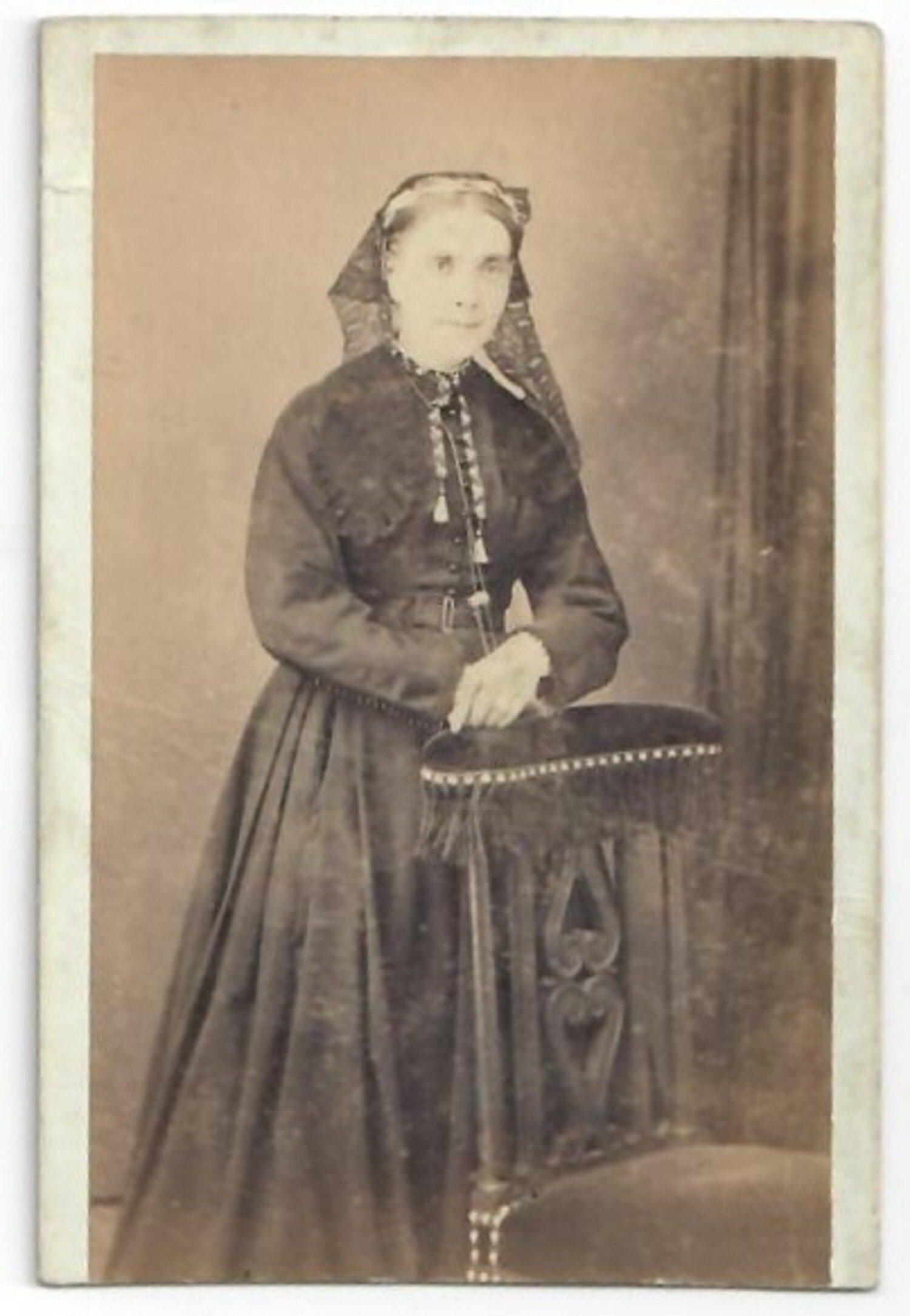 Carte de visite with a woman wearing a black, Chantilly lace lappet (1870s, France, TRC 2021.2009).The more elaborate versions also included decorative pendants at each end, as can be seen in the above photograph. These lappets often hung down the back of the wearer or framed their faces.
In addition to the example mentioned above, the TRC Collection includes several black lace lappets, such as TRC 2007.0604, a black silk Chantilly lappet, and TRC 2007.0575, which is a black silk lappet made in the Le Puy (France) style of lace.
Gillian Vogelsang, Director TRC, 20 June 2021.