Georg Stark is a German, UNESCO-recognised block printer and indigo dyer who promoted the historic craft of textile indigo dyeing in Germany and beyond. The TRC has recently started exploring another subject within the large field of textiles studies. We want to focus on the craftsmen and craftswomen who actually do or did the work and made a difference. We are looking for people who are willing to contribute with a blog. Please let us know whether you can help.
Most textile studies tend to focus on specific techniques, local characteristics, materials that are being used, the tools, the dyes, the uses of the textiles, the garments that are being made, the ornamentation, the household goods and ornamental cloths, and their trade and movement all across the world.
Far less attention is being paid to the people who actually did the work, the men, women and sometimes the children who spun the fibres, dyed the threads, wove the textiles, embroidered and painted them, and sewed them into garments and other objects. Who were these people, who often spent many years learning their craft? Many worked in dusty workshops, in relative anonymity and with very little compensation. Others gained enormous prestige and were employed in royal households. Many of them made a difference. Who were they?
Of course, over time the names of many of these craftsmen and craftswomen were lost, but oral and written sources still sometimes refer to individuals and groups who made a difference, people who were renowned for their skills and introduced new techniques, new materials or tools, gave a new twist to local textile production, or introduced completely new decorative forms. They may also have been instrumental in preserving almost forgotten local forms and techniques. They may have come from far away, bringing with them their own knowledge and skills which they introduced in their new homeland; they may have moved voluntarily or been forced to do so, often in a group, as slaves or prisoners of war. Others may never have left their own little village or town. And some modern artisans are still developing new forms, introducing new techniques, and making a difference!
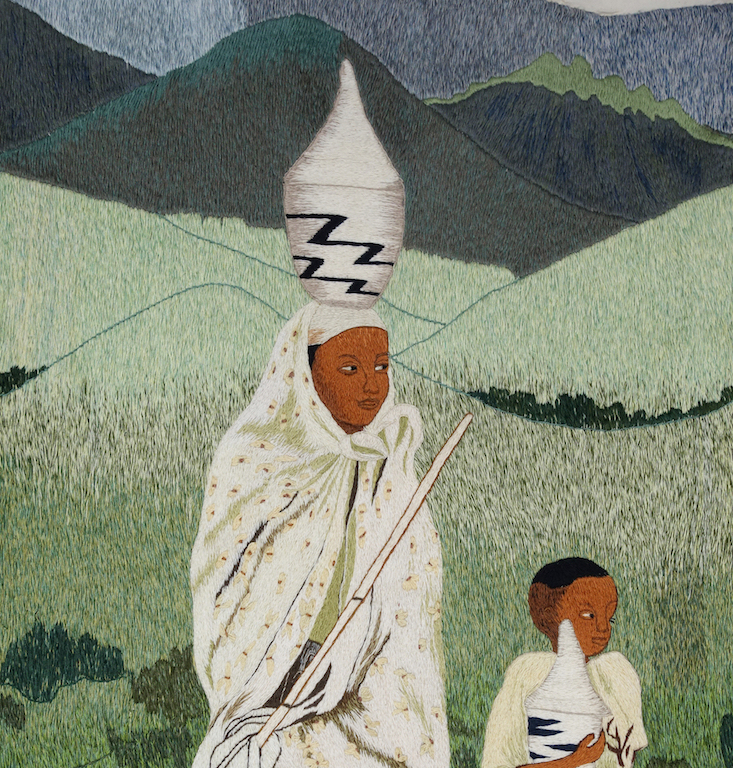 Detail of an embroidered wall hanging created by the Savane Kabuye collective in Rwanda. This collective was established in 1997 by Christiane Rwagatare, and it introduced new techniques and a new representational repertoire for embroideries, in a country devastated by civil war and mass killings.
The Textile Research Centre would like to highlight the men and women, wherever and whenever, individually or in groups, with or without their actual names, in the past or in the present, who developed or introduced changes in local textile production, or were involved in the deliberate preservation of traditional textile crafts that otherwise might have been lost. In this project we would like to give the artisan central place, rather than the object, thereby complementing all our other work.
We are looking for textile enthusiasts who can write stories that tell about these people, about the context in which they worked, about the innovations they brought about or the traditional crafts they preserved, how and why they came to do so, where the innovations came from, who supported or inspired them, or who tried to stop them. We want to hear why some of them were forced to migrate to other places, or why they had to explore new techniques, or find new resources. Where did they find the inspiration and stimulus to develop textile crafts or create new ones?
 Fragment of a wall hanging from Kerman in southeastern Iran. The style and technique of these Kerman cloths were introduced by craftsmen from Kashmir in the 18th and 19th century (TRC 2014.0457).Because of the many uncertainties these days, we feel reluctant to start organising a ‘live’ conference or edit a book on the subject. At the TRC we have learnt, since the start of the corona crisis, that the online exchange of information on the myriad aspects of textiles and dress is appreciated by many and attracts a large following. The TRC blogs are read by thousands and our Facebook following exceeds 12,000 readers. We would therefore like to set up a special series of blogs on the subject of: Textile Artisans that Made a Difference. But we can only do so with the help of others.
We therefore welcome the submission of blogs (some 800-1200 words, but we will be flexible) from all over the world. They should be written in English, for a general audience, and be accompanied by a number of illustrations (max. 6) that are presented free of copyright. All blogs submitted will first be read by a small editorial board associated with the TRC and, if accepted, be edited, if required, in consultation with the author. The process is designed to be very quick and efficient! Ideally, we can do all of this within a week. We would very much like to welcome you to participate and to start writing!
To start with, we will attach the new Artisan blog series, under a separate name, to the well-established TRC blogs and TRC Facebook pages. We are open to all suggestions for further distribution, and we want to publish the blogs at regular intervals.
Please let us know what you think and whether you are willing to write and/or cooperate: This email address is being protected from spambots. You need JavaScript enabled to view it.
Many thanks,
Gillian Vogelsang, Director Textile Research Centre, 23 January 2022