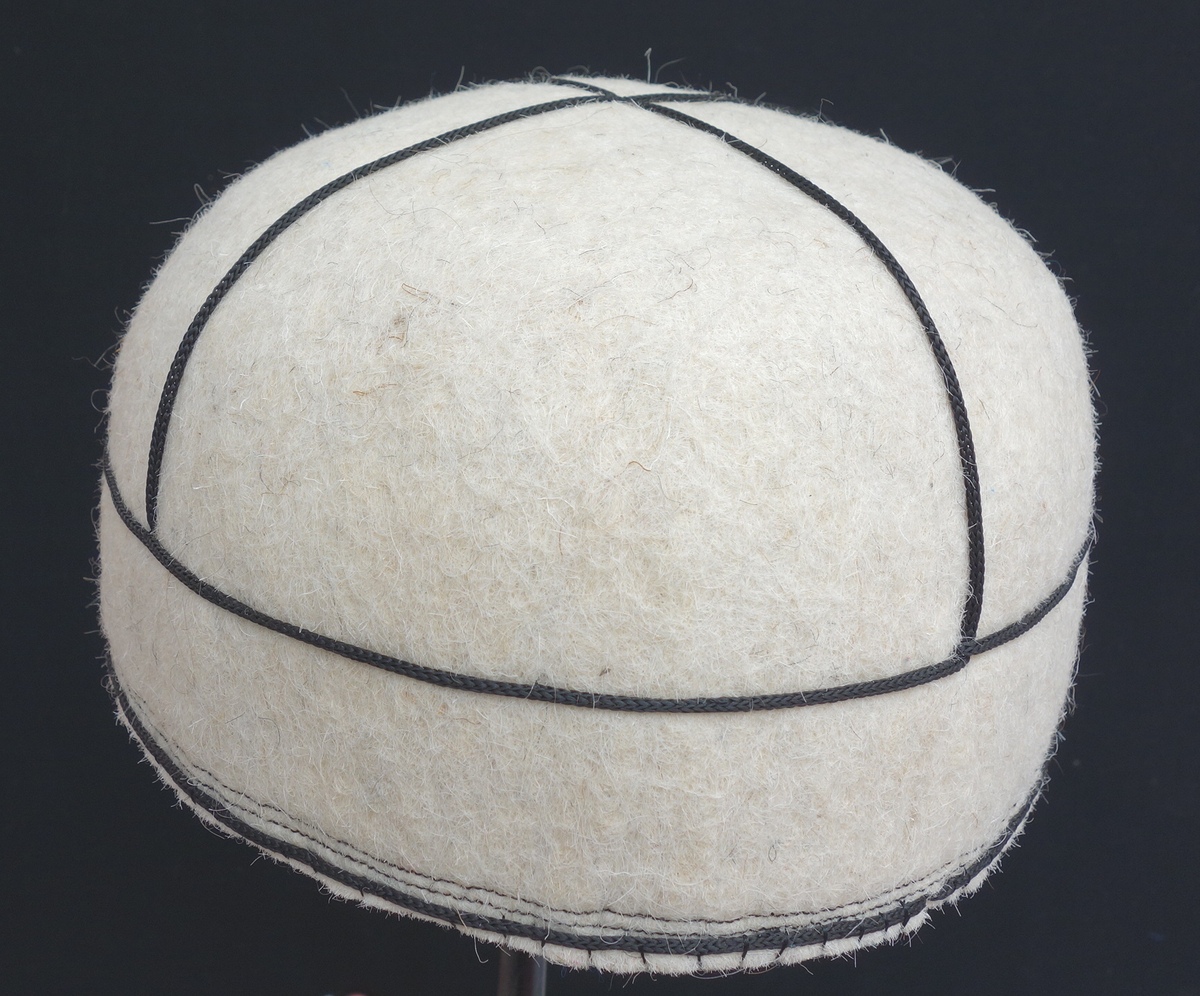
 A white felt hat from the Svan in northwestern Georgia, early 21st century (TRC 2015.0344).The three traditional hats from Georgia in the Caucasus, now in the TRC collection, namely TRC 1998.0027, TRC 1998.0028 and TRC 2015.0344, come in three colours; white, black, and brown. Each of these hats has clear features associated with the styles of the ethnic group of the Svans, or Svani.
The hats from the Svaneti region, in the northwest of Georgia, are made by felting. Felting is the technique of fusing protein fibres, typically sheep’s wool, to create a non-woven fabric. The Svan people tend to press their felted wool into a curved wooden block in order to shape their unique headwear.
The hats are typically hard and rigid: a product of the vast amount of wool compressed firmly into shape. They are fused into a near solid, curved form which is then further supported by cords, which extend from the pinnacle down its sides. Svan hats can feel scratchy to those that don’t wear them every day, however people are known to keep their own specific hats for years or more! So we can imagine that the hats, like shoes, mould to the wearer's individual head.
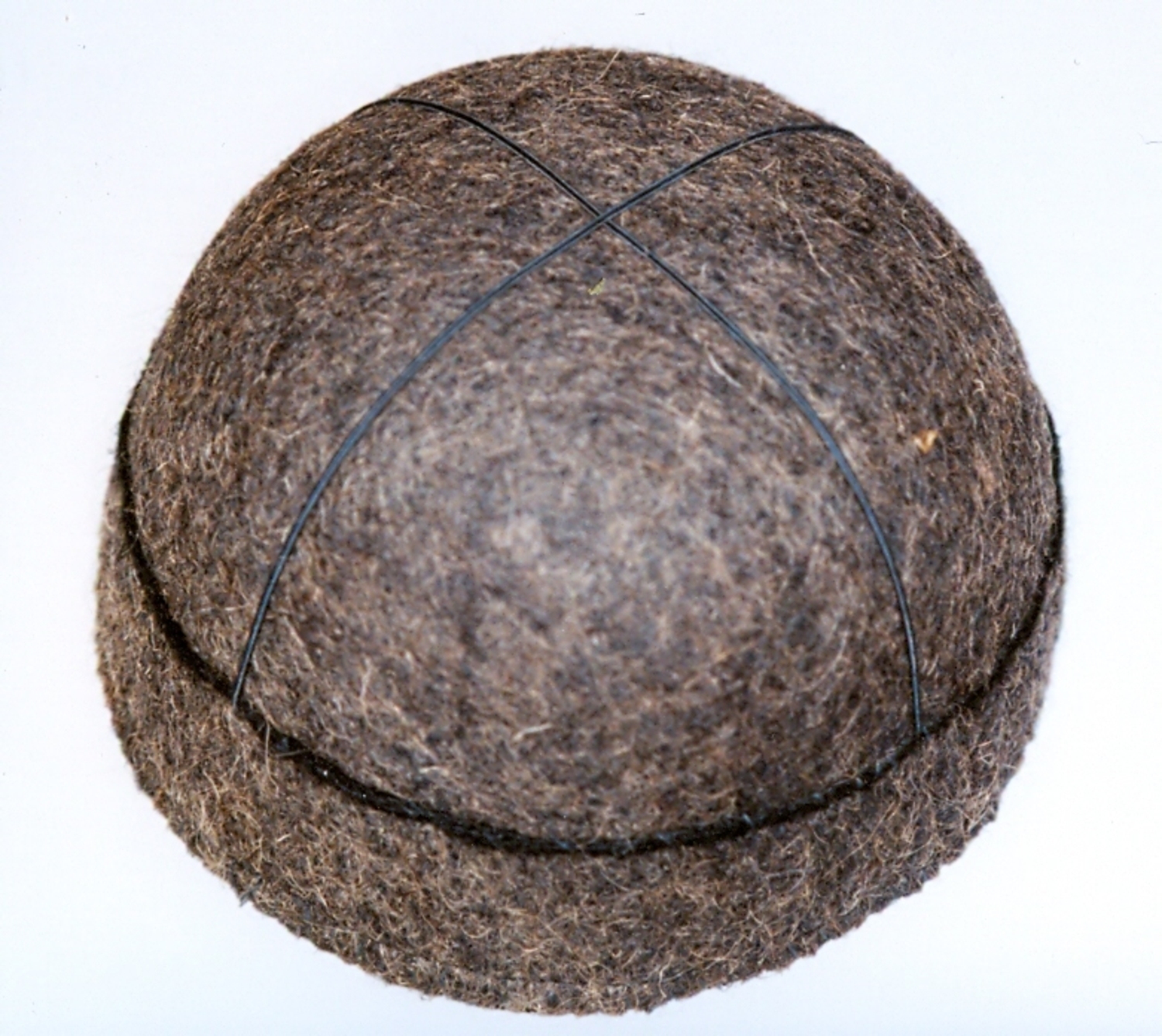 A brown felt cap from the Svan in northwestern Georgia, the Caucasus, late 20th century (TRC 1998.0027).The Svans have been living in villages across the mountain ranges of northwestern Georgia for over 2,000 years, with their most notable settlements being Ushguri, the highest village in Europe, and Mestia.
Many Svans still live by traditional ways, having a life that revolves around farming - with the wheel only being exposed to Svan society in 1935. The traditional family unit is the centre of Svan society, with the man the undisputed head of each family.
Svan hats are an important part of Svan culture. Men traditionally wear the hat, whereas women are forbidden to do so. Only some respected women are invited into the process of making a hat, otherwise a male prerogative. The hats are supposedly worn throughout the day, and even at night whilst sleeping, but they have also been known for their functionality as a water vessel.
A Svan hat can be given as a gift and as a sign of respect for the recipient. Many Svan people still wear the hats each day and believe that it relieves them of ailments. Svan hats are known to come in the colours of the sheep who yield the wool, in brown, black, white, and grey, which is reflected in the depicted pieces from the TRC collection. Black hats are to be worn at times of mourning, grey is for the everyday and white is reserved for joyous occasions.
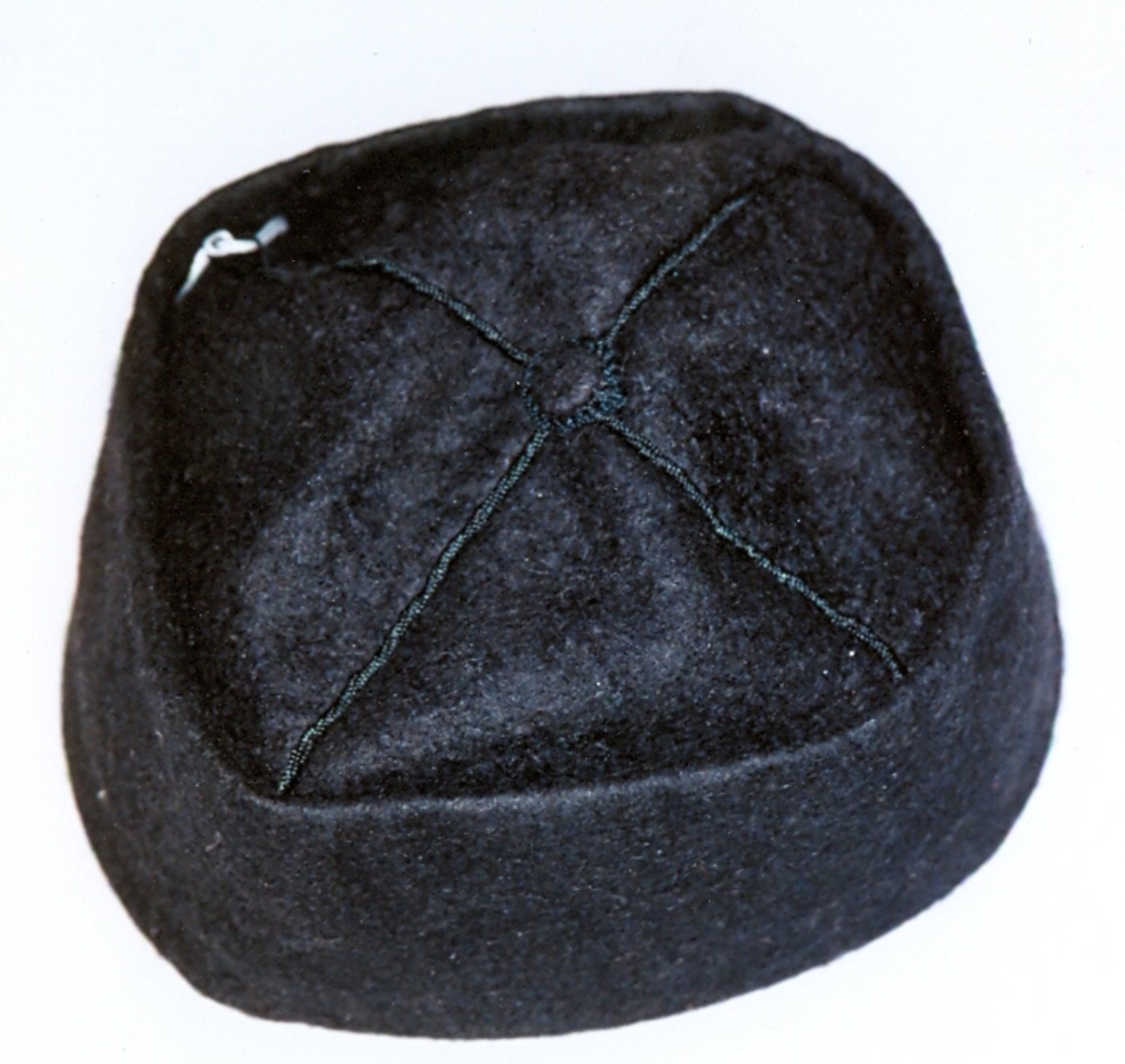 Black felt cap from the Svan in northwestern Georgia, late 20th century (TRC 1998.0028),In recent years, Svan society has experienced changes in the face of contemporary globalised culture. The unwritten Svan language is at risk of dying out as more young people seek work outside rural Svaneti. Svan hats have more recently become a wider national symbol of Georgia after the repression of Georgian culture during the Soviet era.
These changes have come at a time when there is growing expansion of international travel into Georgia, with a specific push of tourism into villages and towns in mountainous areas, especially Svaneti province. The hats are now popular tourist gifts, with hat-making classes an advertised tourist event.
Svan hats are often seen worn alongside a variation of the chokha, which is a woollen coat that is worn by many ethnicities and groups all over the Caucasus. Among many groups, including the Svan, it is typically worn by men and is provided with cartridge holders on the chest. The latter were once basic folds or pockets, but now they are simply ornamental. The TRC soon hopes to receive an example of this type of coat from Georgia in the large donation of garments that is currently being shipped from Arizona in the USA to Leiden.
Variations of the chokha can be seen in the Western fashion world and, like the Svan hat, it is a feature of pre-Soviet Georgian culture that has experienced a renaissance in the post-Soviet era as a symbol of cultural defiance.
The appropriation of the Svan hat as an article of both tourism and nationalism, rather than as a traditional garment and staple tool, mimics the trajectory of the chokha. There is an interesting comparison between the changing utility of the chokha and the Svan hat.
This Swiss army knife of a hat, one which carries water, displays the tone of the occasion, indicates the wearer's home, identity and language, and of course protects the wearer from Svaneti’s harsh winters, is losing its meanings. The multiple details of this hat's traditional uses are being lost through the encroachment of the globalised world, much like the Svan language and culture themselves.
Erica Prus, Central St Martins, University of the Arts, London. 24 January 2022