• F2
  • F1
  • F3
  • F4

Fig. 1. Modern vyshyvanka recently donated to the TRC. Kyiv, Ukraine, polyester, machine embroidered (TRC 2025.0149).Fig. 1. Modern vyshyvanka recently donated to the TRC. Kyiv, Ukraine, polyester, machine embroidered (TRC 2025.0149).If there is one thing I have learned about dress while volunteering at the TRC, it is how inextricably linked clothing is to identity. Dress is a physical marker of identity. It can embody the inexpressible—the sense of belonging to a specific culture, to a distinctive history, and to a specific country. All this carried in a piece of cloth.

Yet it still amazes me how emotive and political clothing can be. The link between identity and dress may become even stronger when that identity is perceived as under threat.

This was brought home to me yet again on a recent Instagram post. The post was from a very upset Ukrainian woman. She was reposting a photograph of a densely embroidered woman’s traditional skirt and blouse. In the original post, the ensemble had been identified as Russian.

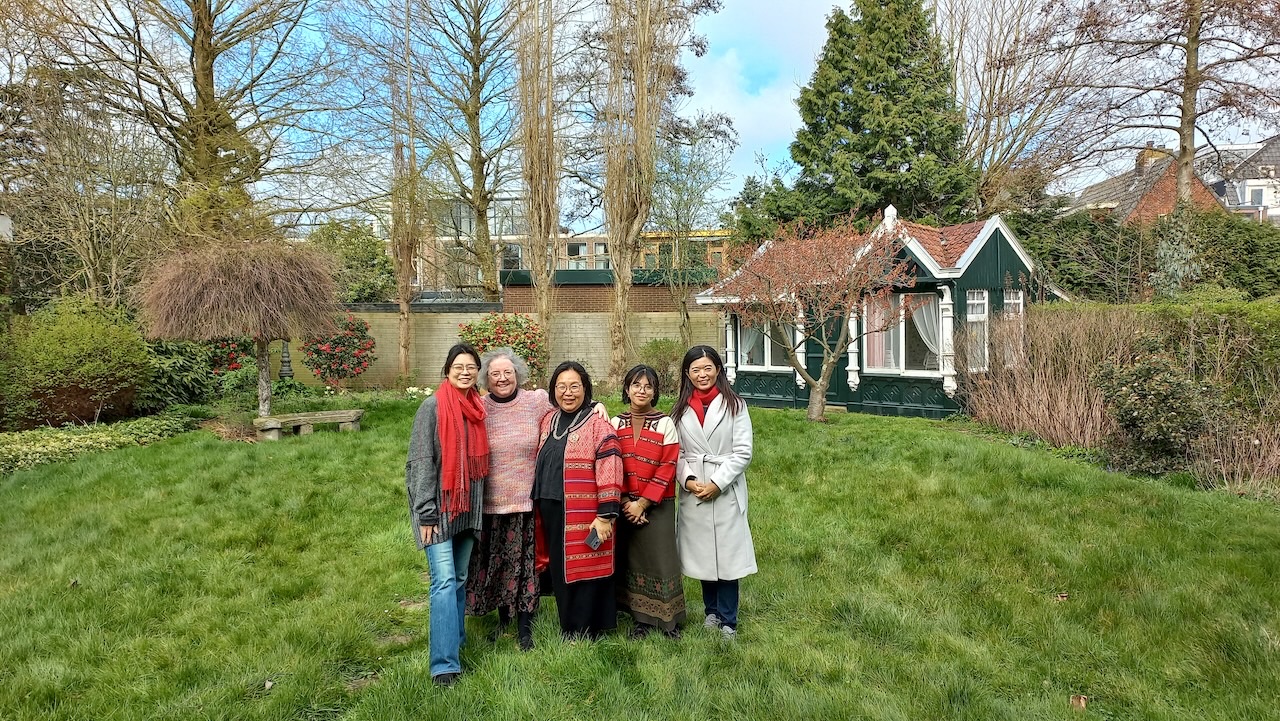
Two visitors in front of Boerhaavelaan 6.Two visitors in front of Boerhaavelaan 6.We have just experienced the Open Monumentendag  (Open Monuments weekend; 13-14 September 2025) at the TRC’s new home, Boerhaavelaan 6 (known as B6 at the TRC), here in Leiden, just behind the railway station.The building has recently been acquired by the Stichting Monumenten Bezit, which will shortly, also thanks to Leiden Council, make it available to the TRC.

It was the first time this historic building had been open to the public and we were involved in such an event. It was a steep learning curve, but great fun, both for us and for the volunteers and organisers of the Monumentendag.

The new TRC home, view from the garden.The new TRC home, view from the garden.On Saturday B6 was open from 12.00 until 17.00 and on Sunday from 10.00 until 17.00. On both days there was a constant flow of people, much to the amazement and delight of all of us.  On Saturday afternoon there were 313 visitors, while Sunday saw well over 650 (I have yet to receive the exact number).

This means that, in total, nearly 1000 people came to see the villa. There were guided tours with a brief introduction being given of its intriguing history, or people could simply wander around the house. As somebody said, the history of the 20th century is encapsulated in this urban villa, which was home to the Barge family (Prof. Barge was the Rector Magnificus of Leiden University from 1937-1938) for nearly 100 years.

Testing natural dyes. Photograph by author.Testing natural dyes. Photograph by author.I attended the five-day TRC Intensive Textile Course, 25-29 August 2025. Below I will describe what we did and what we learnt, and how much I enjoyed the course.

Day 1 was spent looking at and identifying fibres. It was also spent getting to know the amazing people who participated and organised the course, along with taking a quick tour of the TRC. This was an extra special time to look around, as plans for the TRC to move to other, and larger premises were being finalised. It was exciting to get a glimpse into the work being put into moving the collection of more than 51,000 objects from one location to another.

Fibre identification was a great first day activity. It is the most basic part of what makes up a textile, so logically it made sense to start with that, but it was also a great ice breaker. There was a lot of socialising while collecting our fibre samples, as well as a lot of learning, and a group favourite was identification through burning small samples of cotton, flax, silk, wool, and even eyebrow hairs!

Fig. 1. Woven mat (losa), made from reed or bark, from the Mbola, Democratic Republic of the Congo, late 20th century (TRC 2025.1290).Fig. 1. Woven mat (losa), made from reed or bark, from the Mbola, Democratic Republic of the Congo, late 20th century (TRC 2025.1290).Over the last year or so, Marjolijn van Scherpenzeel (Hartendief, Leiden), has given us a large quantity of textiles, mainly from Central Africa, Thailand and Laos, as well as various religious garments and embroideries from Western Europe.

Marjolijn has just given us some more pieces that we are gradually sorting out. Among the donation are some woven panels of a type I have never seen before. They are about 50 x 35 cm in size and are made from reed or strips of bark, stained black, white, red and yellow.

The pieces are now in the TRC Collection (TRC 2025.1284 to TRC 2025.1325) and are decorated with a variety of woven, geometric patterns. The mats or losa are made by Mbole women who live in the Democratic Republic of the Congo (formerly known as Zaire). They belong to the Mongo people and live in the equatorial forests in northeastern Congo.

Fig. 2. Woven mat (losa), made from reed or bark, from the Mbola, Democratic Republic of the Congo, late 20th ntury (TRC 2025.1321).Fig. 2. Woven mat (losa), made from reed or bark, from the Mbola, Democratic Republic of the Congo, late 20th ntury (TRC 2025.1321).These mats are not woven on a loom, but rather in the hand in a similar manner to a basket, with weft threads that are individually threaded using a twill weave (including 3/1 and 4/1 twill forms) into the required pattern.

The geometric patterns are apparently based on kengo or body tattoo patterns, known in general as itoko and come with a variety of names, such as bilik (bricks; Fig. 1. TRC 2025.1290), eleko (feather; Fig. 2. TRC 2025.1321), kitiwala (bed, TRC 2025.1294) and koi (leopard or leaping power of the leopard; TRC 2025.1324 and TRC 2025.1325).

We are planning a small exhibition about these pieces that will take place once we have moved into the new TRC home later this year!

Gillian Vogelsang, 7 September 2025

Sources

In Qing society, garment decoration, such as embroidered and woven motifs, were often embedded with meaning, signalling the wearer’s values, identity, and their social and political status. The upper classes were familiar with and able to both convey and read the iconography of embroidery and woven decoration that adorned their garments and accessories.

Fig. 1. A woven rank panel with the design of a bird (crane) facing towards a red sun. China, 19th century (TRC 2016.2363).Fig. 1. A woven rank panel with the design of a bird (crane) facing towards a red sun. China, 19th century (TRC 2016.2363).

The meaning of the decoration was determined by the subject matter or motifs depicted, and the layout or framework in which the motifs were placed. The placement of the imagery on the garment, together with its content, signify how the motifs are to be interpreted. Compositions in the Qing dynasty can be categorised into four styles: bordered, dispersed, consolidated, and integrated.

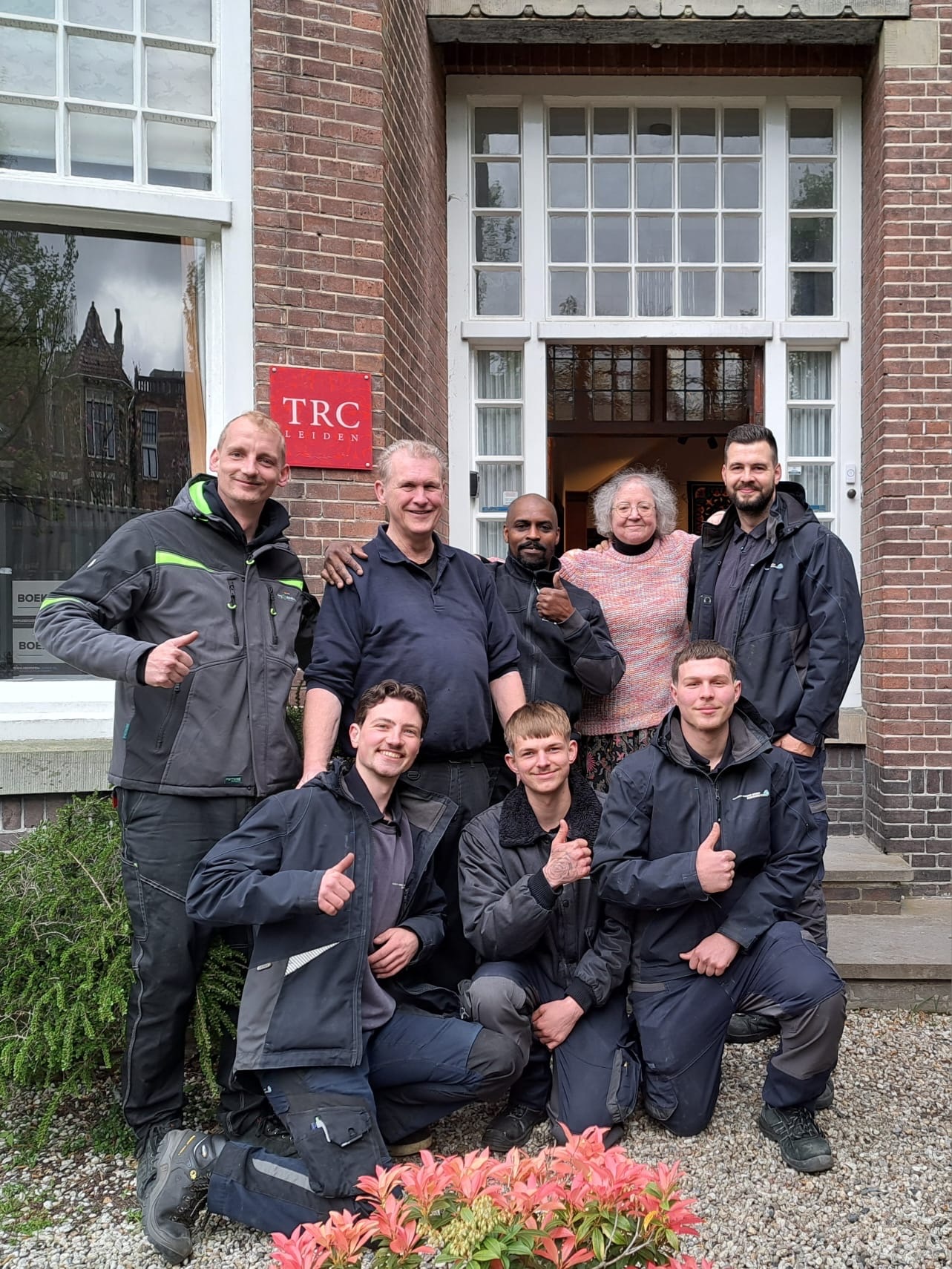
Augusta de Gunzbourg (r) and Gillian Vogelsang (l) proudly showing the keys to Boerhaavelaan 6 (Leiden), the planned new home of the TRC.Augusta de Gunzbourg (r) and Gillian Vogelsang (l) proudly showing the keys to Boerhaavelaan 6 (Leiden), the planned new home of the TRC.Well, there we are: This morning we received the keys to the urban villa in Leiden where, we hope, the TRC will continue its activities, before the end of the year. The house is owned by Monumentenbezit, a national organisation that manages a wide series of monumental buildings in the Netherlands, including churches and castles. A few weeks ago it also became the owner of this lovely building in the centre of Leiden, just behind the central railway station, namely Boerhaavelaan 6.

We have not yet signed the final rental contract, but we already can show people around who will help us with moving as well as interior work such as cleaning, painting, carpets, etc. We will also be helping to prepare the building for visitors during Monumenten Weekend, 13-14 September, when we hope to welcome anyone interested in the building itself and in the plans of the TRC.

The house was designed by the famous Leiden architect, Hendrik Jesse, and dates from 1909. For long it was the family home of Prof. Ton Barge (1884-1952), a former chancellor of Leiden University (1937-1938) and member of the Eerste Kamer (Senate) from 1937-1949, as well as an outspoken opponent of national-socialistic influences at the University. A plaque attached to the house commemorates his protest speech on 26 September 1940 against the racial theories of the Nazis and the dismissal from Leiden University of Jewish colleagues.

We shortly hope to provide more information about the house, Monumenten Weekend, and the plans of the TRC, but in the meantime, perhaps we can welcome you on Saturday 13 September, 12.00 – 17.00, or on Sunday 14 September, 10.00 – 17.00?

Gillian Vogelsang, 3 September 2025

Last month, Gillian and I made a quick dash to southern France to see various dear friends. We first went to visit Mohammad Khairzada, who together with his wife and children found a safe haven in France some years ago when the Taliban took control of Afghanistan. Khairzada studied with us in Leiden in 2007-2008, and returned to his country to conduct various archaeological excavations in and around Kabul, among other places at the famous Buddhist site of Mes Aynak. I regularly met him again at the Dutch embassy in Kabul and elsewhere when I worked in Uruzgan, in the south of the country, between 2008 and 2011.

We also went to see Joanne and Luc Aujame, who have a beautiful farmhouse just outside of Lyon. Luc lived in Kabul as a child, many years ago, together with his parents. His father, Roger Aujame, and his mother, Edith Schreiber-Aujame, were architects and urban planners who worked in the Afghan capital from 1961-1965. Some time ago, Luc and his wife donated a large number of Afghan garments to the TRC, including textiles and other objects from Nuristan (Fig. 1), formerly known as Kafiristan, east of Kabul. They also gave the TRC a large number of scans of colour photographs taken in Afghanistan in the early 1960s.

Fig. 1. Prayer mat from Nuristan, Afghanistan, 1960s (TRC 2022.1936). Aujame Family donation.Fig. 1. Prayer mat from Nuristan, Afghanistan, 1960s (TRC 2022.1936). Aujame Family donation.

Fig 1: First impression of the Vasa ship. The picture does not do justice to the sheer size of this beauty. Photograph by author.Fig 1: First impression of the Vasa ship. The picture does not do justice to the sheer size of this beauty. Photograph by author.During a trip to Stockholm I visited the Vasa ship museum. This place highlights a spectacularly preserved Swedish warship Vasa that sank in 1628. You're faced with the massive ship front as soon as you walk in and it is absolutely breathtaking (Fig 1).

Because the ship was wrongly weighted it never made it out of the bay, sinking only minutes after its departure. The ship is preserved in its entirety and was carefully dredged out of the sea in the 1960s, conserved, and placed into the Vasa museum.

Fig 2: Showcases in front of the ship with preserved jackets, buttons (very similar in style to TRC 2024.2729 and TRC 2024.2618), brocaded fabric, shoes and mittens. Photograph by author.Fig 2: Showcases in front of the ship with preserved jackets, buttons (very similar in style to TRC 2024.2729 and TRC 2024.2618), brocaded fabric, shoes and mittens. Photograph by author.The museum beautifully highlights the textile finds from this site (see Fig 2). Underwater archaeology is a keen interest of mine as it is one of the few ways organic material can be preserved. So items such as textile, leather and wood that would usually long since have decayed often remain.

Items from the 17th century at the TRC are really limited to some velvet coths and buttons, but I realised while visiting just how much I understood about these items due to my time at the TRC.

Search in the TRC website

Contact

Boerhaavelaan 6
2334 EN Leiden.
Tel. +31 (0)6 28830428  
office@trcleiden.org 

facebook 2015 logo detail 

instagram vernieuwt uiterlijk en logo


Bank account number

NL39 INGB 0002 9823 59, in the name of the Stichting Textile Research Centre.

TRC closed until 4 May 2026

The TRC is closed to the public until Monday, 4 May 2026, due to our move to the Boerhaavelaan. The TRC remains in contact via the web, telephone and email. For direct contact and personal visits, please contact the TRC at office@trcleiden.org, or by mobile, 06-28830428.

Donations

The TRC is dependent on project support and individual donations. All of our work is being carried out by volunteers. To support the TRC activities, we therefore welcome your financial assistance: donations can be transferred to bank account number (IBAN) NL39 INGB 000 298 2359, in the name of the Stichting Textile Research Centre. BIC code is: INGBNL2A.

 You can also, very simply, if you have an iDEAL app, use the iDEAL button and fill in the amount of support you want to donate: 


Since the TRC is officially recognised as a non-profit making cultural institution (ANBI), donations are tax deductible for 125% for individuals, and 150% for commercial companies. For more information, click here