• F3
  • F1
  • F2
  • F4

It is not often that you see the entrance to a military museum covered with hundreds of colourful cotton Buddhist prayer flags (see a previous blog, dated 16 August 2014). But that is what first greets the visitor to the latest exhibition of the National Military Museum (in Soest, the Netherlands). The prayer flags are not the only textiles in the exhibition “Genghis Khan: World Conqueror”. There are some 800 objects on view, most of them on loan from the Inner Mongolia Museum in Hohhot, China.

The bulk of the objects relate to Genghis Khan (1162-1227) himself or to the Mongol Empire he created during 21 years of constant war. The objects include iron arrows from the Liao Dynasty (circa 907-1125 CE); quivers of birch bark or leather from the early 13th century; an 800-year old iron helmet; and a silver saddle and stirrups used today in ceremonial sacrifices to Genghis Khan. There are also beautifully preserved garments from China’s Yuan Dynasty (1260-1368 CE), the period when Genghis Khan’s grandson, Kublai Khan, united and ruled over China.

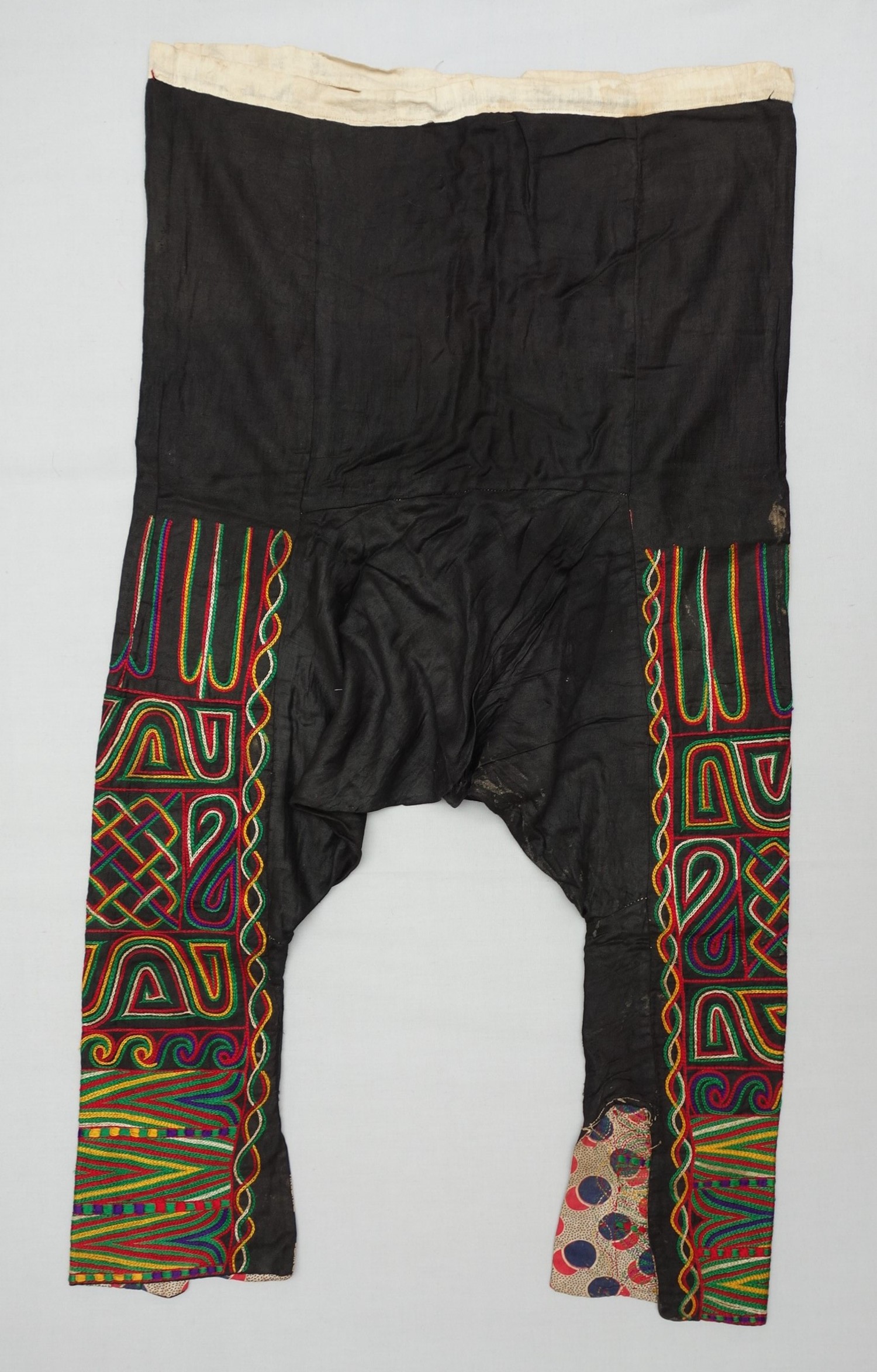
The first Yuan garment is a pair of baggy silk trousers, excavated in 2010. These trousers would be worn by a wealthy Mongol man, under a long sleeved silk robe that would reach above his ankles. The Chinese had been spinning and weaving silk for over 2000 years by this time; in some parts of China bolts of silk had been used as currency. Wearing silk was a public statement of wealth and power that the Mongols eagerly adopted.

Also on display is a government official’s robe made of hemp and cotton, in what looked to me like damask. Kublai Khan had decreed that all official uniforms had to have the right side of the robe folded over the left. This was a reversal of tradition. Interestingly, this man’s robe had a left lapel. A subtle sign of resistance to Mongol authority? Or some lower level bureaucrat who could not afford a newer robe?

Another Yuan robe, also a man’s, is similar in shape but of much better quality. This robe is woven with gold thread (nasij) in a pattern of sphinxes with crowns on their heads. Nasij is a brocade. The word comes from the Persian for ‘gold thread’. This type of weaving was highly prized by the Mongols, who reportedly moved whole villages of weavers from Central and Western Asia to China, in order to teach Chinese weavers how to make this cloth of gold.

In another part of the exhibition there is another Yuan-period garment. This is a Barag Mongol tribe woman’s dress, a silk brocade robe with long sleeves and puffy shoulders. Two modern garments are also on display. One is a modern Sunit man’s robe and trousers, the other a modern Mongol wrestler’s outfit, with a leather harness, baggy trousers and high leather boots.

There are other interesting objects pertaining to dress. One is a shaman’s robe (Qing Dynasty, 1644-1911), a gown covered in long, broad, multi-coloured silk ribbons, some of which end in red tassels. The ribbons are thought to symbolize feathers, indicating that the shaman (who could be female or male) could turn into a bird and fly. Bells, arrows and animal bones are also sewn on the garment, as are differently sized bronze discs, used as mirrors. A mask is also worn with the dress during ceremonies.

One other object deserves mention. This is a gugu crown, worn by upper-class married Mongol women. This one, too, is from the Yuan period. It is a tall, cylindrical object, made from bamboo and covered in silk and jewelry. It’s bifurcated at the top. Given the bamboo frame, such high status objects are fragile and rarely found intact.

“Genghis Khan: World Conqueror” is open now until 27 August 2017.

Shelley Anderson, 26 March 2017

Leila Ingrams, 1940-2015Leila Ingrams, 1940-2015Among the recent acquisitions to the TRC Collection are several unusual and interesting groups of objects. These include a small number of Yemeni garments given by the family of Laila Ingrams, who died recently. She was the daughter of Harold and Doreen Ingrams, the famous British writers and explorers of the Arabian Peninsula. The garments include items for both men and women. One of the more intriguing items is a dress from the island of Socotra, which lies to the south of Yemen. The TRC already has a comparable garment, also from Socotra. We are still very puzzled about exactly how these garments were worn, so if you know and/or have photographs could you please let us know at This email address is being protected from spambots. You need JavaScript enabled to view it.?

In complete contrast, Pepin van Roojen of Pepin Press (Amsterdam) has donated a collection of textiles and garments that include Islamic fashion, Chinese clothes, as well as, yes, cowgirl outfits and garments from the USA. The latter are especially welcome as they will help to build up our North American collection. We are going to create various digital exhibitions about these items.

As part of the Pepin donation there was also a large number of old postcards that are going to be scanned and put online for all to enjoy. These include Dutch costumes as well as many from the Middle East. In addition, there are a number of swatch books (from the USA, France and The Netherlands) as well as hundreds (literally) of textile samples dating to the 20th century, which were the property of an art expert in Paris, who worked with various Parisian fashion houses. Many of these samples are printed and represent typical and atypical textiles from the 20th century European/Western fashion market.

Gillian Vogelsang-Eastwood, 19 March 2017


Impression of the Hermitage exhibition, "1917: Romanovs and Revolution"Impression of the Hermitage exhibition, "1917: Romanovs and Revolution"“1917: Romanovs and Revolution” is the newest exhibition at the Hermitage in Amsterdam. It’s a timely exhibition, marking the centenary of the two revolutions that rocked Russia in 1917. The first revolution began on International Women’s Day (March 8) when women textile workers marched in the streets of Petrograd (now St. Petersburg) for an end to food shortages. Within days there was a general strike, and demonstrators were also demanding an end to Russia’s involvement in World War 1. It was this February Revolution which ended the 300-year-long Romanov monarchy.

A visitor learns this and much more from the excellent information texts (in Dutch and English) and the accompanying free audio guide. What is perhaps surprising is the substantial number of textiles on display. This includes a beautiful silk and wool wall hanging; and over a dozen garments worn by Tsar Nicholas II, Tsarina Alexandra (who was a granddaughter of Britain’s Queen Victoria), their five royal children, and other wealthy Russians of the time. Elite fashion was strongly influenced by the Art Nouveau movement, with multiple layers of rich, often semi-transparent fabric in strong colours, decorated with lace, beads and sequins. Hem length aside, many of the evening gowns could be worn on the cat walk today. Wealthy Russians had access to leading French fashion houses, as the green crepe-de-chine and silk atlas summer dress designed by couturier Paul Poiret shows. But the Romanov’s court also wore the creations of Russian designers, such as Anna Gindus’s silk and chiffon evening dress, decorated with glass beads, lace and fur; or the silk dresses on display by Nadezhda Lamanova.

There were several textiles that stood out for me. One was a red, short sleeved evening gown made of gauze, faille and tulle, with a beautiful floral beaded trim and fringe. Many Russians decorated their clothes with traditional peasant motifs during World War I, as a sign of patriotism. The beading reflects this. There is also a white cambric dress from the same period, decorated with Valenciennes lace, elaborate cutwork and English embroidery. Most evocative of all, however, were three day dresses, mostly of pink silk and gauze, worn by three of the Romanov princesses. This was displayed alongside a boy’s velvet military jacket worn by the Tsarevich.

“1917: Romanovs and Revolution” is not a fashion exhibition. But among the glassware, Faberge jewelry, military samovars and cooking pots (also made by Faberge for the war effort, along with hand grenades and artillery shells) are many photographs and prints, which illustrate the clothing worn by both ordinary people and the elite. There is also a collection of 32 porcelain figurines, given to the Tsar as a birthday gift, which show some of Russia’s minority communities (e.g., Mongol, Ainu, Armenians, Kazachs) in traditional dress. There is much to see for anyone interested in dress.

“1917: Romanovs and Revolution” is on until 17 September 2017.

Shelley Anderson, 10 March 2017

The TRC has a new acquisition: two pussy hats (TRC 2017.0186 and 0187). Pussy hats are hand-made, square-shaped caps made from wool or acrylic yarn, usually coloured pink. They can be knitted, crocheted or sewn. After Donald Trump won the US presidential election in November 2016, American knitters attempted to make over one million of such hats, to be given as gifts for marchers to wear at the Women’s March in Washington, DC. Patterns for the simple hat were shared via the Pussyhat Project website (www.pussyhatproject.com) and Facebook; many craft shops hosted groups of knitters making the hats. There were news reports of craft shops in different American cities being sold out of pink yarn. The deadline was 21 January 2017, the day of the Women’s March.

When a pussy hat is worn on the head, two tips appear, similar to a cat’s ears. This is not the origine of the cap’s name, however. The word ‘pussy’ in English is an insulting term for a woman’s genitals. In October 2016, during the presidential election campaign, The Washington Post newspaper released a video and accompanying article on lewd remarks made by Donald Trump about women. Recorded in a television studio parking lot in 2005, Trump told a television host: “I moved on her like a bitch, but I couldn't get there, and she was married. …I'm automatically attracted to beautiful [women]—I just start kissing them. It's like a magnet. Just kiss. I don't even wait. And when you're a star they let you do it. You can do anything ... Grab them by the pussy. You can do anything."

The remarks outraged many as condoning sexual assault. Trump was forced to apologize publicly for the remarks. #Pussygrabsback became a popular hashtag; an artist put the words across a picture of a snarling cat’s face and created a popular T-shirt. Knitters Krista Suh and Jayna Zweiman of Los Angelos, California (USA) thought of creating a symbol for women’s solidarity and so launched the Pussyhat Project: "It's reappropriating the word 'pussy' in a positive way….Wearing pink together is a powerful statement that we are unapologetically feminine and we unapologetically stand for women’s rights." Their knitting instructor, Kat Coyle, created a pattern that could be easily customized. All three wanted to celebrate the traditionally female work of knitting and crochet: "Knitting circles are sometimes scoffed at as frivolous 'gossiping circles,' when really, these circles are powerful gatherings of women, a safe space to talk, a place where women support women."

By December the group had collected sixty thousand hats, sent to them from all fifty US states—and from Europe and New Zealand. The pussyhat had gone international. So had the Women’s March. Scheduled for 21 January 2017, the day after Trump was inaugurated as US President, the March’s aim was to make a powerful statement for human rights. The organizers hoped two hundred thousand people would show up. Instead, over half a million came. Crowd specialists calculated that the protest march drew three times the number of people Trump’s inauguration had attracted. More than four hundred similar ‘Sister Marches’ took place all over the US, involving an estimated two million people. There were almost 200 further marches in solidarity all over the world, throughout Europe, Africa, Asia and the Pacific, South America. There was a march in Iraq; another one inside a cancer hospital in Los Angeles and yet another on a research ship in Antarctica. Three thousand people gathered in front of the National Museum in Amsterdam for the March and another one thousand in the Hague. Worldwide between three to four million people participated on 21 January. And a good number of them wore pink pussyhats.

The pink woollen hats now in the TRC collection were made by the Rev. Ramona Scarpace on a circle frame. One (TRC 2017.0187) was worn on 21 January 2017 at the Women’s March in St. Paul, Minnesota (USA) by the knitter's partner, the Rev. Georgianna Smith. The official police estimate for the number of participants at this march was ninety thousand people.

23 February 2017. Shelley Anderson

The Tassenmuseum, AmsterdamThe Tassenmuseum, AmsterdamIt’s always fun to sneak a peak inside someone else’s hand bag. Especially when the hand bag belongs to royalty. That is exactly what visitors get to do at the latest exhibit at Amsterdam’s Museum of Bags and Purses (Tassenmuseum). The exhibition “Royal Bags: Bags of European Royal Families” (on until 26 February) displays bags and purses that belonged to Queen Victoria and Queen Elizabeth I; Empress Sisi of Austria, Princess Grace of Monaco and Queen Elizabeth II.

Sisi had particularly well-stocked travel luggage; Princess Grace’s brown leather bag by Hermes is still produced and known by her last name: the Kelly bag. Queen Elizabeth II famously carries an ingenious little hook which is used to hang her bag from tables. Both these royals’ bags held or hold little except a handkerchief, glasses and lip stick. The Dutch Royal family is not neglected: on display are three handbags personally chosen by Queen Maxima from the former Queen Juliana’s collection. One of them, a golden handbag, has also been carried on different state occasions by Queen Maxima herself.

The display is an interesting statement on the role fashion plays in establishing status and authority. The Museum’s permanent display of bags and purses also makes a visit worthwhile. The Tassenmuseum is only one of three hand bag museums in the world, and the only one of its kind in Europe. Its collection of over 5000 bags and purses is amazing. The permanent display gives the history of the European purse from the 1500’s onwards, from a mediaeval English alms purse to an elegant Chanel hand bag. In its earliest form, mostly worn by men, leather bags with drawstrings were worn from belts to carry objects like coins, gaming pieces, combs or religious relics. The oldest bag in the collection is on display, a goatskin bag with 18 compartments (some of them secret), worn by a 16th century man in France.

By the 17th century pockets began to appear in men’s clothing, so it was women who mostly used bags, to carry money, sewing equipment, keys, combs and writing tablets. One of my favourite objects on display is a rare pair of stocking purses—beautifully embroidered pear-shaped bags (usually of cotton or linen), with strings so they could be tied around the waist. A woman would wear these bags under her skirt, on each hip. There were slits in her skirt to allow access to the bags. I also enjoyed the beautiful nineteenth century beaded bags. In the early nineteenth century these bags were knitted with glass beads (usually from Czech or Bavarian glass factories). Fifty thousand beads had to be strung in the right order before knitting began, so as to produce the right design. No wonder each bag took about two weeks to complete. By the end of the nineteenth century it became cheaper to weave such bags. The bags were still beautiful—and practical, just as today’s bag. The Tassenmuseum’s collection is on-line, with information in both Dutch and English: www.tassenmuseum.nl  

Shelley Anderson, 19 February 2017

The TRC has recently been given a hand-knitted Fair Isle cap (TRC 2017.0006) for a child, by a good friend of the TRC's, namely Brigitta Schreuder. Her father-in-law used to travel in the 1960s as a guest on merchant ships and went to many places around the world. He would buy a souvenir at each of his ports of call, including the Fair Isle, which is an island that lies off the northern coast of Scotland. It belongs to the Shetland Island group. The island has long been famous for the production of knitted goods, including caps, gloves, jumpers, and so forth, which were originally worn by the fishermen, but became fashion statements in the twentieth century. The cap now in the TRC collection has been examined by Lies van de Wege (TRC volunteer) and she has made a pattern chart that can be used for knitting, embroidery, beadwork, and so forth. So have a look and enjoy!

Here is the original:

Fair Isle knitted cap. TRC 2017.0006Fair Isle knitted cap. TRC 2017.0006


Jane Austen (1775-1817), by Cassandra Austen, c. 1810.Jane Austen (1775-1817), by Cassandra Austen, c. 1810.This morning Willem and I spent several house at the National Portrait Gallery (NPG), here in London. It was amazing to see so many of the original portraits (and some new ones) again that we had used for entries in TRC Needles - especially the Tudor and Stuart portraits with their blackwork collars, ruffs, embroidered gloves and so forth. We saw for instance the portrait of Katherine Parr, the sixth wife of Henry VIII. We also saw a double portrait of Lady Dacre and her son George (c. 1559). The same formidable lady is also portrayed (click here) on a canvas now in the National Portrait Gallery of Canada, made by the Dutch artist Hans Ewouts.

We sneaked a look at the tiny miniature of Jane Austen - it is so delicate. Last summer we visited various places linked to her, as for instance her grave in Winchester Cathedral and the house where she died, but also the places where she walked around, and danced, in Bath (see our blog of 7 August 2016).

It is worth noting that the NPG has a fashion trail by Lucinda Chambers, the Fashion Director of the British Vogue. It is callled "Height of Fashion Trail" and covers 500 years of British fashion in a select number of portraits. It would be fun to do an embroidery and/or lace trail using the NPG Collection!

Gillian Vogelsang-Eastwood, 20 January 2017

Embroidered prayer mat from AfghanistanEmbroidered prayer mat from AfghanistanLast night (19th January 2017) Willem and I attended the official opening of a beautiful exhibition about embroidered and woven textiles and garments at the Brunei Gallery (SOAS) in London. The exhibition is called "Embroidered Tales, Woven Dreams" and was curatored by Marian Bukhari. It will be on display until the 25th March 2017. The exhibition includes a wide range of textiles and garments from Afghanistan, Central Asia, the Indian subconintent, as well as the Middle East. The chance to see such a wide range of objects in one location is worth an applause and a visit to the exhibition.

Many of the items on display come from Marian Bukhari's personal collection, as well as several other private collections. The exhibition is designed to show the lives of various groups whose ancestors lived along the famous Silk Road. The stated aim of the exhibition is to tell the story of these people (past and present) and how as their: "embroideries flourished, they became a record of their history, social customs, folk tales and myths as heredity wisdom and skills were passed down from mother to daughter in an attempt to guard their techniques and traditions in textiles."

The exhibition is displayed on three floors of the Brunei Gallery and includes a series of regionally dressed mannequins, a wide range of embroidered textiles (hanging and on panels), paintings, manuscripts, as well as stylised, life-sized cut-outs of camels and oxen (which may sound a little strange but they do add to the atmosphere of the exhibition). There is also a series of tableaus that depict various groups, such as a large 'orange' room with a tableau featuring what appears to be a wedding group. I say what appears to be with a degree of caution because when we were there there were no text boards yet in the exhibition that explain individual groups or objects, which was somewhat disappointing. Text boards with the very general line of "Afghanistan", "Indus" etc, are present, but nothing else.

As noted by Marian Bukhari in her opening speech, she wanted the individal embroideries to speak for the women who made the objects (although in some cases some of the items on display were probably made by men in professional workshops, rather than by women at home). There were also technical problems with the exhibition because of the delay in the arrival of essential display materials and many items that should have been displayed were not presented on the opening night. I understand that next week all the items will be displayed and information about the individal items will be added to all of the pieces as they are not only beautiful and a feast for the eyes, but, as stated by Marian Bukhari, they also have stories behind them and I would dearly love to 'hear' some of these stories as well.

Giliian Vogelsang-Eastwood, 20 January 2017

Search in the TRC website

Contact

Boerhaavelaan 6
2334 EN Leiden.
Tel. +31 (0)71 5134144 (office hours)  
office@trcleiden.org 

The TRC is open every day from 10.00 to 15.00

facebook 2015 logo detail 

instagram vernieuwt uiterlijk en logo


Bank account number

NL39 INGB 0002 9823 59, in the name of the Stichting Textile Research Centre.

Donations

The TRC is dependent on project support and individual donations. All of our work is being carried out by volunteers. To support the TRC activities, we therefore welcome your financial assistance: donations can be transferred to bank account number (IBAN) NL39 INGB 000 298 2359, in the name of the Stichting Textile Research Centre. BIC code is: INGBNL2A.

 You can also, very simply, if you have an iDEAL app, use the iDEAL button and fill in the amount of support you want to donate: 


Since the TRC is officially recognised as a non-profit making cultural institution (ANBI), donations are tax deductible for 125% for individuals, and 150% for commercial companies. For more information, click here