It is exactly one year ago that the TRC, as well as much of the Netherlands, was forced to shut its doors because of the corona virus, but at that time with the expectation that it would only be for a few months and then life would get back to normal. And although between June and November last year we could welcome small groups of visitors and participants to a limited number of lectures, workshops and courses, we are still far from a return to normal!
However, we have not been wasting our time. We organised two onsite and online exhibitions, firstly Textile Tales from the Second World War and more recently From Buteh to Paisley: The history of a global icon (which is receiving more and more international attention). We will extend the paisley exhibition until the end of the summer, so we hope you will have the opportunuty to visit this magnificent display.
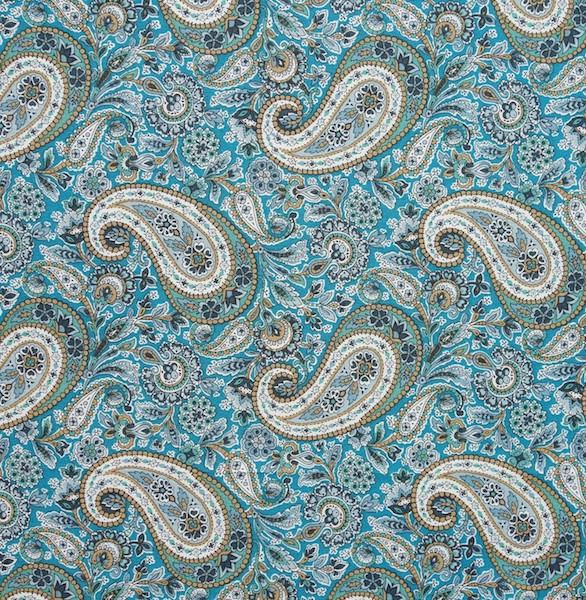 Sample of the Lee Major design, developed for Liberty of London, co. 2020. Donated by Liberty to the TRC collection in February 2021 (TRC 2021.0639).We have also been thinking hard about a range of events that can be organised at the TRC later this year. We hope that the TRC will be able to re-open its doors in April, but this is up to the Dutch government and the relevant corona regulations. And if a third wave hits the Netherlands then this may not be possible. So we are actively planning a programme of events, courses, study days, workshops, etc., which will take place from the summer onwards. In other words, as soon as possible we hope to welcome all textile enthusiasts back to the TRC, and we will make sure that during much of the summer holidays the TRC will remain open for people to see the paisley exhibition and to attend a variety of textile events.
A small group of dedicated volunteers at the TRC has been working very hard on extending the (online) TRC Library catalogue and getting the TRC Collection in order and based on our experiences during the last few weeks, this may take some time! Why? Because of the number of boxes that keep arriving with donations! They came from all over the world, literally from America to Japan. The boxes and other recent donations included a diverse group of items, including a group of paisley textiles donated by Liberty of London, an American military uniform and wedding dress, Japanese embroidered jackets based on American baseball jackets, Japanese beaded bags, an intricate Chinese embroidery, a collection of Mexican woven clothes, as well as Guatemalan and Mexican garments (two different donors).
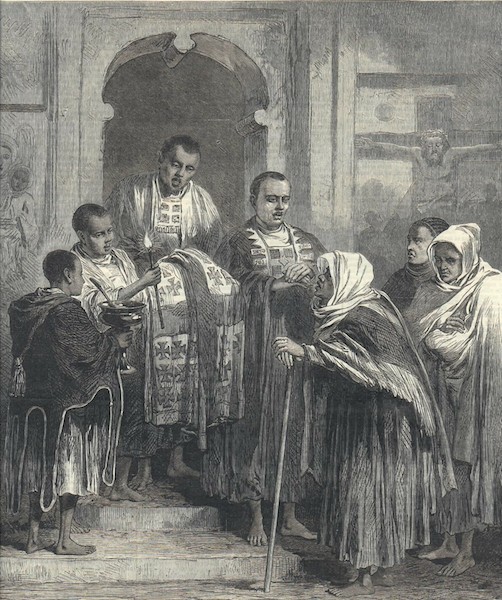 Print in The Illustrated London News, 15 August 1868, with two priests and two assistants, all dressed in different liturgical vestments. Acquired for the TRC collection in early 2021, and to be used for the third volume of the Bloomsbury World Encyclopedia of Embroidery, edited by the TRC (TRC 2021.0623).
There has also been a collection of lace and lace making equipment used by a Dutch lady from the 1920’s to 1940’s, two pairs of boots (one pair of which with thick wooden soles) made in the Netherlands during the Second World War, and last, but by no means least, a small collection of kris, the long daggers from Indonesia that are associated with elite men. And last Tuesday someone from Leiden came with an Ethiopian cape with, to my eyes, an unusual shape that could accommodate a rifle. A very practical garment!
All in all, these items reflect the diverse and intriguing nature of (a) textile technology and (b) dress and identity, the two core businesses of the TRC Leiden. And all of these pieces have different stories to tell and we will be gradually publishing them in a series of TRC Blogs as well as adding details, information and links in the (online) TRC Collection database.
During 2020, the TRC became a haven for various MA students from Leiden University who want to acquire practical experrience in various curatorial activities, such as collection management, setting up exhibitions, answering enquiries by email and/or telephone, object photography, and so much more. Learning how to make exhibitions by participating in all the processes, from the basic idea, to dressing figures, writing object texts, numbering, as well as creating a 'walk' through the various parts of the display offered an enjoyable challenge and something they can be proud of.
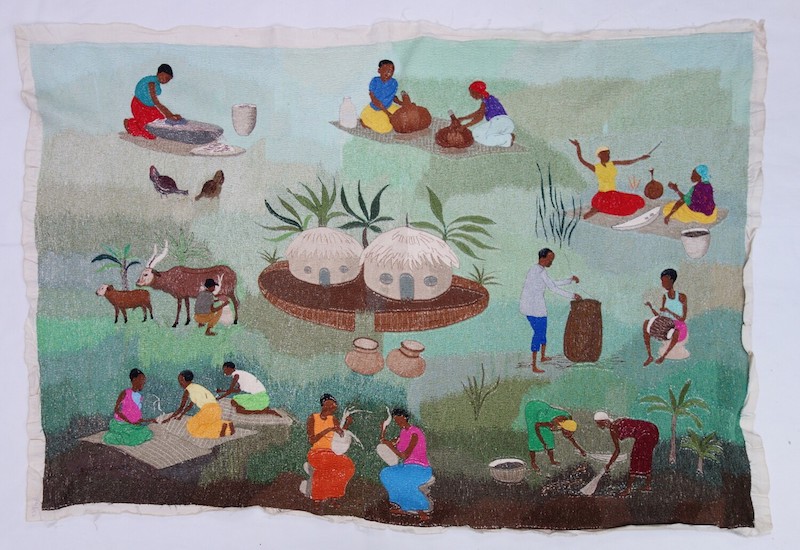 Embroidered panel made by the Savane Kabuye group in Rwanda, donated to the TRC in January 2021 (TRC 2021.0500a).We have also been working on two major projects. The first is the third volume of the Bloomsbury World Encyclopaedia of Embroidery, which is about embroidery from Sub-Saharan Africa. It will include well-known items such as the boubou from West Africa and embroidered dresses from Ethiopia. But there is so much more to embroidery from this part of the world. We are receiving help in this work from various specialist and general readers from around the world and thanks to everyone it is going to be an intriguing volume that will contain numerous surprises. We hope to submit the manuscript by the end of this summer, after which our attention will turn to the fourth volume of the series, namely the embroidery from Western Europe and Scandinavia. Considerable work has already been done on this subject, and we hope to complete the manuscript by the summer of 2022. Of course we were encouraged by the publication, mid-January, of the second volume, on embroidery from Central Asia, the Iranian Plateau and the Indian subcontinent.
The second major project involves putting all of the TRC’s collection of American quilts and coverlets into the Quilt Index. This is an international project headed by Prof. Marsha MacDowell, Michigan State University, USA. The TRC’s quilt collection came about thanks to a grant from the American Embassy, The Hague and we now have one of the larger and most diverse American quilt collections in this part of Europe. One of our plans is to have a quilt and quilting centre based at the TRC, in which the 2,500 plus years of this textile technique can be explored by as many people as possible.
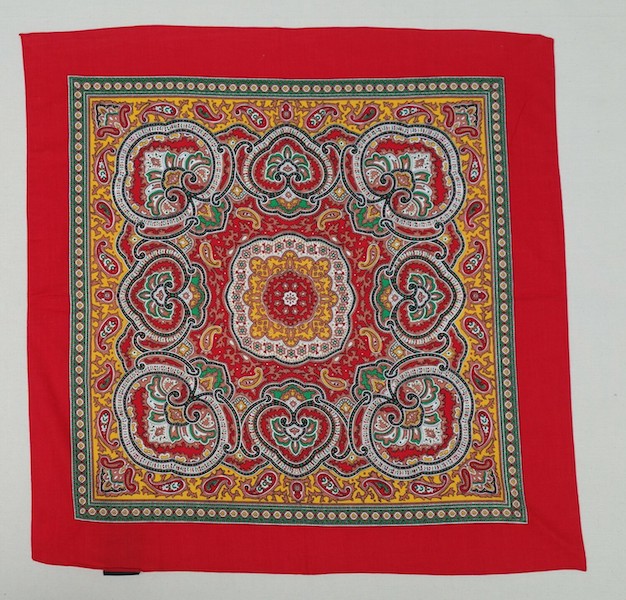 Modern scarf from the island of Kihnu in Estonia, with paisley motifs. Donated to the TRC in early February 2021 (TRC 2021.0408d).Finally, we completed the Annual Report 2020 a lot earlier than in previous years, but it still contains a wealth of information on the TRC and its w
Because we cannot welcome visitors to the TRC Leiden, for the exhibitions and events, and indeed people simply browsing through the items in our shop, we do need extra help from everyone who knows and have enjoyed the activities of the TRC. Financial donations to help with the daily running of the TRC Leiden are essential. Please support us by transferring your donation to: NL39 INGB 0002 9823 59, in the name of: Stichting Textile Research Centre. Since the TRC is a recognised ANBI (Cultural Institution), your donation, if you pay taxes in the Netherlands, is tax deductible for up to 125%. You may also simply use the iDEAL-button below. For American tax payers, the 501(c)(3) regulations apply, which means that donations are also tax deductible.
In addition, as part of the TRC’s vision for the future and indeed with its determination to continue despite the strange times we live in, we are looking for a patron! Someone or indeed an institute that loves textiles, understands the important role textiles play in the lives of everyone, and is willing to financially support the TRC over the next few years. We want to expand and spread the word about the stories behind the cloth! If you are willing to help or know of someone/an institute that is in a position to assist, please let me know at This email address is being protected from spambots. You need JavaScript enabled to view it..
Gillian Vogelsang-Eastwood, Director TRC, 16 March 2021.